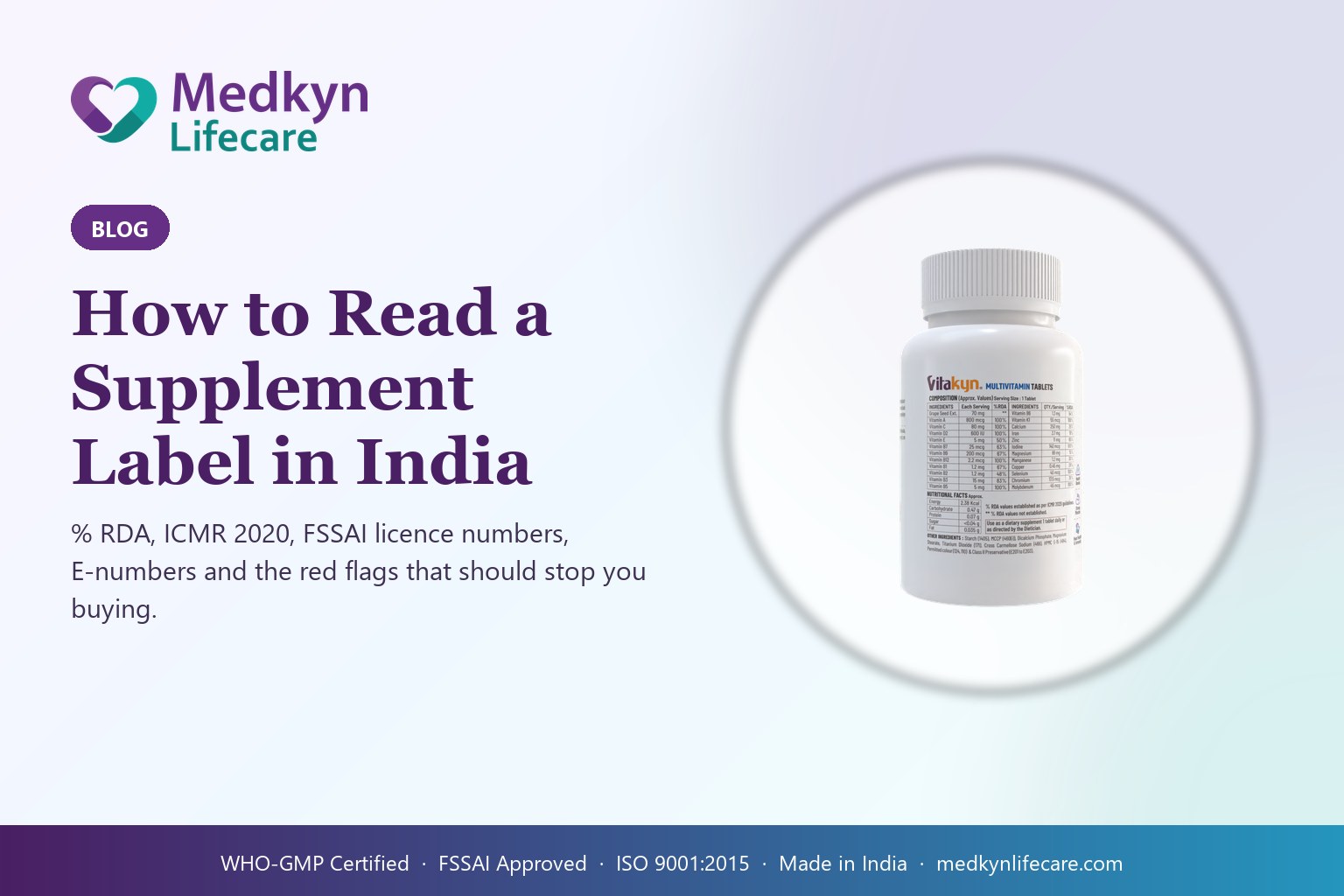
An Indian nutraceutical label is a regulated document, not a marketing panel. FSSAI's 2022 regulations require a composition table with the quantity of every active per serving, a % RDA figure against the ICMR-NIN 2020 values, a full list of other ingredients, the manufacturer's and marketer's FSSAI licence numbers, and the statement "Not for medicinal use". Once you know where each line comes from, a label tells you in thirty seconds whether a product is worth your money — and whether the company behind it is worth your trust.
Why the label is the most honest thing about a supplement
Advertising can say "clinically inspired" or "advanced formula". The label cannot. Under the Food Safety and Standards (Health Supplements, Nutraceuticals, Food for Special Dietary Use, Food for Special Medical Purpose, and Prebiotic and Probiotic Food) Regulations, 2022 — and the general Labelling and Display Regulations of 2020 — every element on an Indian nutraceutical pack is prescribed. That makes the label the one place where a manufacturer has to put numbers next to claims. Let's walk through one, section by section, using the back panel of Vitakyn Multivitamin as the worked example.
1. Product name and category statement
The name must not imply a disease claim. "Vitamin B12 Tablets" is fine; "Nerve Cure Tablets" is not. Nearby you should find the category statement — typically "Nutraceutical" or "Health Supplement" — which tells you which FSSAI schedule the product is made under. If the pack says neither and instead reads like a medicine, it is either a licensed drug (look for a drug licence number) or mislabelled.
2. Composition table: the part that matters most
This is the heart of the label. It lists each active ingredient, the quantity per serving and the % RDA. Three things to check:
- Serving size. Usually "1 tablet" or "1 sachet". If it says "2 tablets", halve every figure to compare with a competitor.
- The form of the nutrient. "Calcium citrate 1000 mg (eq. to elemental calcium 250 mg)" is an honest label — it tells you the salt and the elemental amount your body actually receives. A label that says only "Calcium 1000 mg" without specifying the form is ambiguous.
- Units. Vitamins are declared in mg, mcg (micrograms) or IU (international units). 600 IU of vitamin D equals 15 mcg; 2.2 mcg of vitamin B12 is 100% of the Indian RDA. Small numbers are not weak doses — they reflect how little of some vitamins the body needs.
3. % RDA and what "ICMR 2020" means
RDA is the Recommended Dietary Allowance — the daily intake that meets the needs of nearly all healthy people in a group. Indian labels reference the ICMR-NIN 2020 tables published by the Indian Council of Medical Research's National Institute of Nutrition. The % RDA column shows what share of that daily target one serving delivers.
Two footnotes appear on almost every pack:
- "% RDA values established as per ICMR 2020 guidelines" — the reference used for the percentages.
- "** % RDA values not established" — flagged against ingredients like curcumin, grape seed extract or amla, for which India has no RDA. This is normal and honest; it is not a gap in the product.
Under FSSAI rules, a health supplement generally should not exceed one RDA of a vitamin or mineral per day. So a label showing 100% RDA for vitamin A or B12 is at the ceiling by design. Labels boasting "500% RDA" are describing either a product that is not compliant or one that is regulated differently.
- Composition table present, with quantity and % RDA per serving.
- Nutrient forms named (citrate, cyanocobalamin, cholecalciferol) and elemental amounts given.
- "Nutraceutical. Not for medicinal use." printed clearly.
- Two FSSAI licence numbers — marketer and manufacturer — 14 digits each.
- Batch number, manufacturing date, expiry date and MRP fields present.
- No disease-cure language anywhere on the pack.
4. Nutritional information
Separate from the composition table, this panel lists energy (kcal), carbohydrate, protein, sugar and fat per serving. For a tablet the numbers are tiny — a Vitakyn Multivitamin tablet declares 2.38 kcal and under 0.04 g sugar. The panel matters more for sachets, gummies and syrups, where sugar can be substantial. Diabetics should read it every time.
5. "Other ingredients" and E-numbers
Everything that is not an active ingredient — binders, fillers, coatings, colours, sweeteners, preservatives — must be listed. These appear with INS or E-numbers in brackets, which are the internationally agreed codes for food additives. A few you will see often:
| Code | Name | Role |
|---|---|---|
| 460 / 460(i) | Microcrystalline cellulose (MCCP) | Binder and filler — plant-derived |
| 1405 | Starch (enzyme-treated) | Disintegrant / filler |
| 466 | Croscarmellose sodium | Helps the tablet break up in the stomach |
| 464 | HPMC | Coating; also the shell of vegetarian capsules |
| 171 | Titanium dioxide | White pigment in coatings |
| 441 | Gelatin | Soft gel shell — animal origin, hence non-veg |
| 201–203, 211 | Sorbates / sodium benzoate | Class II preservatives |
| 955 | Sucralose | Non-caloric sweetener (sachets, chewables) |
None of these is a hidden ingredient; their presence is what a transparent label looks like. What should concern you is a label with no "other ingredients" line at all — every tablet needs excipients, and a label that omits them is incomplete.
6. The green or brown dot
Indian law requires a vegetarian (green) or non-vegetarian (brown) symbol on food products, including nutraceuticals. It refers to the whole product — shell included. A fish oil soft gel in a gelatin shell carries the brown mark. All Vitakyn products carry the green mark except Omega 3 Fish Oil, which is correctly marked non-vegetarian.
7. "Marketed by" vs "Manufactured by" and the FSSAI numbers
Many Indian brands sell products made at a partner facility. The label must show both parties: the marketer (the brand owner responsible to the consumer) and the manufacturer (the licensed facility), each with a 14-digit FSSAI licence number. You can enter either number on FSSAI's FoSCoS portal to confirm the licence is valid and matches the address on the pack. A brand with no FSSAI number on the label is not legally on the market.
8. Directions, warnings and the compliance line
Look for the dosage direction ("1 tablet daily or as directed by the dietician"), storage advice ("store in a cool, dry place, protect from sunlight"), "keep out of reach of children", and the mandatory phrase "Nutraceutical. Dietary supplementary food. Not for medicinal use." Sachets and granules should also give reconstitution instructions — for example, dissolve one sachet in 100 ml of water.
9. Batch number, dates and MRP
Batch number, manufacturing date and expiry date are printed at the packing line and link the pack to its Certificate of Analysis. If these fields are blank or smudged, do not buy. The MRP must be "inclusive of all taxes".
Red flags that should end the conversation
- Disease claims: "cures diabetes", "reverses arthritis", "prevents Covid".
- No composition table, or actives listed without quantities ("proprietary blend 500 mg").
- No FSSAI licence number, or a number that fails on the FoSCoS portal.
- % RDA figures far above 100% for vitamins and minerals.
- No "other ingredients" list — every tablet has excipients.
- No manufacturer address, only a PO box or website.
- Missing or hand-written batch and expiry.
Read the label, then read the credentials
A compliant label tells you the product is what it says. The manufacturer's credentials — WHO-GMP, ISO 9001:2015 and a valid FSSAI licence — tell you it was made the way it says. Together they are the whole story. Every Vitakyn and Argikyn label is reproduced line by line on its product page so you can check both before you buy.
Frequently asked questions
What does % RDA on a supplement label mean?
% RDA shows what share of the Recommended Dietary Allowance — the daily intake that meets the needs of nearly all healthy people — one serving of the product provides. Indian labels use the ICMR-NIN 2020 RDA tables. For example, 2.2 mcg of vitamin B12 per tablet is declared as 100% RDA because that is the adult Indian RDA.
Why do some ingredients show "% RDA not established"?
Because India has no official RDA for that ingredient. Botanical extracts such as curcumin, amla or grape seed, and nutrients like DHA, have no ICMR-NIN RDA, so the label marks them with ** and the footnote "% RDA values not established". It is a legally required, honest disclosure — not a sign of a weak or unapproved ingredient.
How do I verify an FSSAI licence number?
Every Indian nutraceutical pack must carry the 14-digit FSSAI licence numbers of the marketer and the manufacturer. Enter the number on FSSAI's FoSCoS portal (foscos.fssai.gov.in) to confirm it is active and that the licensed name and address match the label. A product with no FSSAI number is not legally on the market.
What does "Not for medicinal use" mean on a supplement?
It is a mandatory FSSAI statement declaring that the product is a food — a nutraceutical or health supplement — intended to support normal health or fill a nutritional gap, and not a drug for treating disease. Products that treat or cure conditions must be licensed as medicines under the Drugs and Cosmetics Act instead.