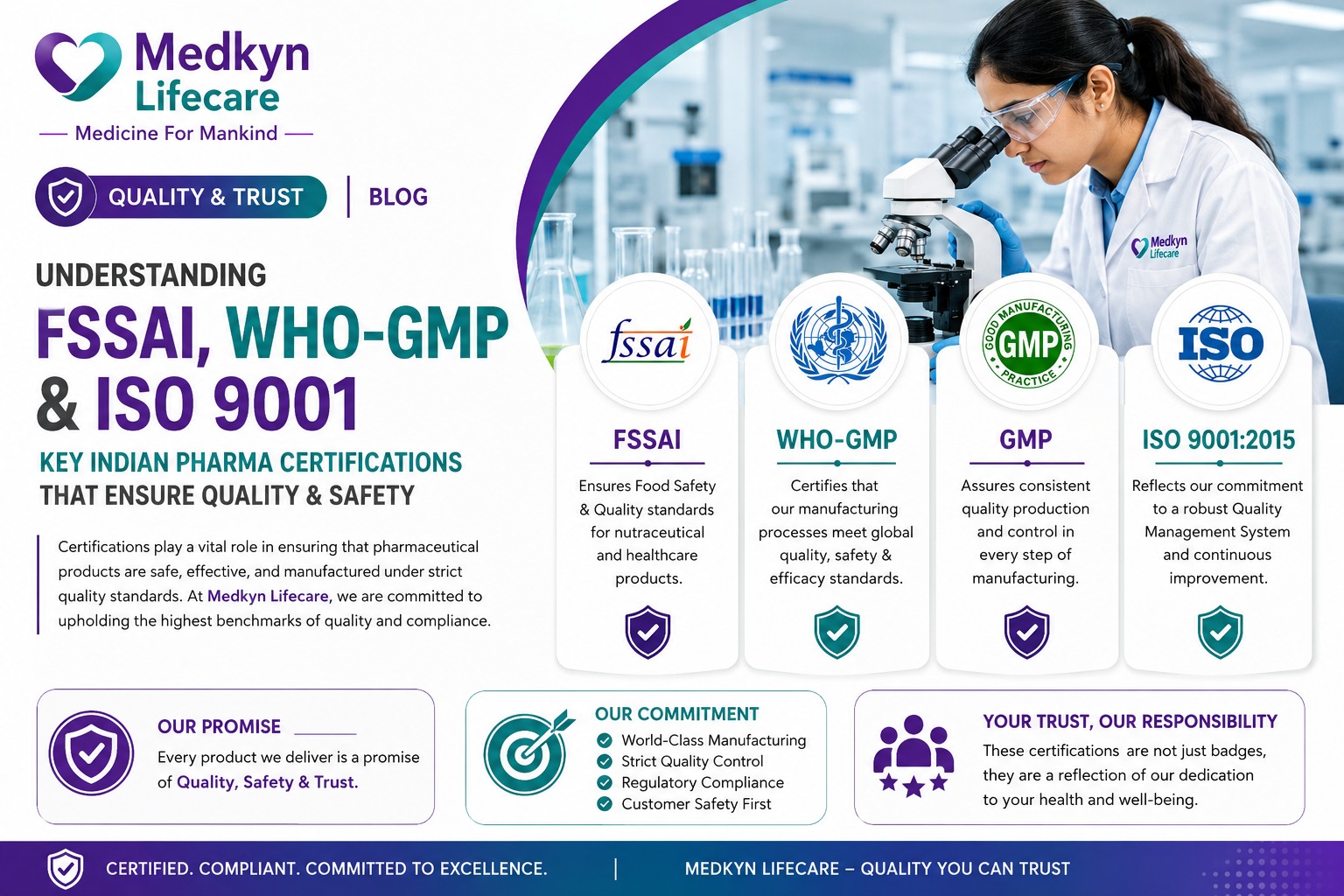
FSSAI, WHO-GMP, and ISO 9001:2015 each verify something different: FSSAI is the mandatory food-safety licence for nutraceuticals in India, WHO-GMP is the pharmaceutical manufacturing-quality endorsement, and ISO 9001:2015 is a voluntary international quality-management standard. Reading all three together — not any one in isolation — is how a buyer judges a manufacturer. Medkyn Lifecare, Ahmedabad, holds all three, plus GMP, across both its pharmaceutical and nutraceutical production.
If you have ever compared two supplement suppliers and seen the same alphabet soup of logos on both, you will know the problem: certifications are easy to display and hard to interpret. FSSAI, WHO-GMP, and ISO 9001:2015 are the three credentials you will encounter most often when sourcing pharmaceuticals or nutraceuticals from India, and they are frequently treated as interchangeable. They are not. Each is issued by a different body, governs a different aspect of quality, and answers a different question. This guide explains what each one verifies and why the strongest manufacturers hold all of them at once.
What is FSSAI certification?
FSSAI stands for the Food Safety and Standards Authority of India, a statutory body established under the Food Safety and Standards Act and operating under the Ministry of Health & Family Welfare. It is the national regulator for food, and that remit explicitly includes nutraceuticals and health supplements.
What FSSAI actually verifies
FSSAI licensing or registration is mandatory: you cannot legally manufacture or sell nutraceuticals in India without it. Its focus is food safety in the broadest sense — hygienic manufacturing conditions, accurate and compliant labelling, and the use of permitted ingredients at permitted levels. For a supplement brand, an FSSAI licence is not a nice-to-have or a marketing badge; it is the legal foundation that allows the product to exist on a shelf at all.
What is WHO-GMP certification?
WHO-GMP stands for World Health Organization Good Manufacturing Practice. It is the version of Good Manufacturing Practice guidelines published by the World Health Organization and adopted internationally as a baseline for pharmaceutical manufacturing quality. In India, a WHO-GMP certificate is issued by the State Licensing Authority following a facility audit.
What WHO-GMP actually verifies
Where FSSAI asks "is this food safe to sell?", WHO-GMP asks "is this product made under a controlled, documented, repeatable process?" Its focus is manufacturing quality: validated processes, complete documentation, batch traceability from raw material to dispatch, and release testing against specification. Because the standard is internationally recognised, a WHO-GMP certificate is also export-relevant and is typically required for institutional and tender supply. We cover this credential in depth in our guide to what WHO-GMP certification means for pharma manufacturers in India.
What is ISO 9001:2015 certification?
ISO 9001:2015 is the international Quality Management System (QMS) standard published by the International Organization for Standardization. Unlike the other two, it is industry-agnostic — the same standard certifies factories, software firms, and logistics companies. It is also voluntary: no Indian law requires it.
What ISO 9001:2015 actually verifies
ISO 9001:2015 does not certify a product. It certifies that an organisation runs a managed quality system — consistent processes, defined responsibilities, measurable objectives, and a documented cycle of continual improvement and customer-satisfaction monitoring. When a manufacturer holds ISO 9001:2015, it signals that the discipline you see on the production line is backed by a management system designed to keep it consistent over time, not just on the day of an audit.
Why do all three certifications matter together?
The reason these three are so often confused is that they overlap in spirit while differing in substance. No single one of them gives a complete picture, because each verifies a different layer. FSSAI confirms the product is legal and food-safe; WHO-GMP confirms it is manufactured to pharmaceutical-grade process discipline; ISO 9001:2015 confirms a management system sits behind both. A manufacturer with only an FSSAI licence has met the legal minimum but proven nothing about manufacturing rigour. A useful way to read them side by side is in the table below.
| FSSAI | WHO-GMP | ISO 9001:2015 | |
|---|---|---|---|
| What it covers | Food safety, hygiene, labelling, permitted ingredients | Pharmaceutical manufacturing process, documentation, batch traceability | Quality management system, processes, continual improvement |
| Who issues it | Food Safety and Standards Authority of India | State Licensing Authority (WHO guidelines) | Accredited certification bodies (ISO standard) |
| Mandatory? | Yes — to sell nutraceuticals in India | GMP (Schedule M) is mandatory for pharma; WHO-GMP is required for export and tenders | No — voluntary |
| Best signal for | Legal, food-safe supplements | Pharmaceutical-grade manufacturing rigour | A disciplined, well-managed organisation |
It is also worth noting that India has its own statutory GMP framework under Schedule M of the Drugs and Cosmetics Rules, which is mandatory for licensed pharmaceutical manufacturers. WHO-GMP builds on that base with an internationally recognised, export-grade endorsement.
How does Medkyn Lifecare hold all three?
Medkyn Lifecare, Ahmedabad, holds WHO-GMP (World Health Organization Good Manufacturing Practice), FSSAI (Food Safety and Standards Authority of India), ISO 9001:2015, and GMP certification — and applies them to both pharmaceutical and nutraceutical production. That last point matters: many supplement makers hold an FSSAI licence alone, but Medkyn manufactures its nutraceuticals under the same WHO-GMP discipline and ISO 9001:2015 quality system that govern its pharmaceutical output.
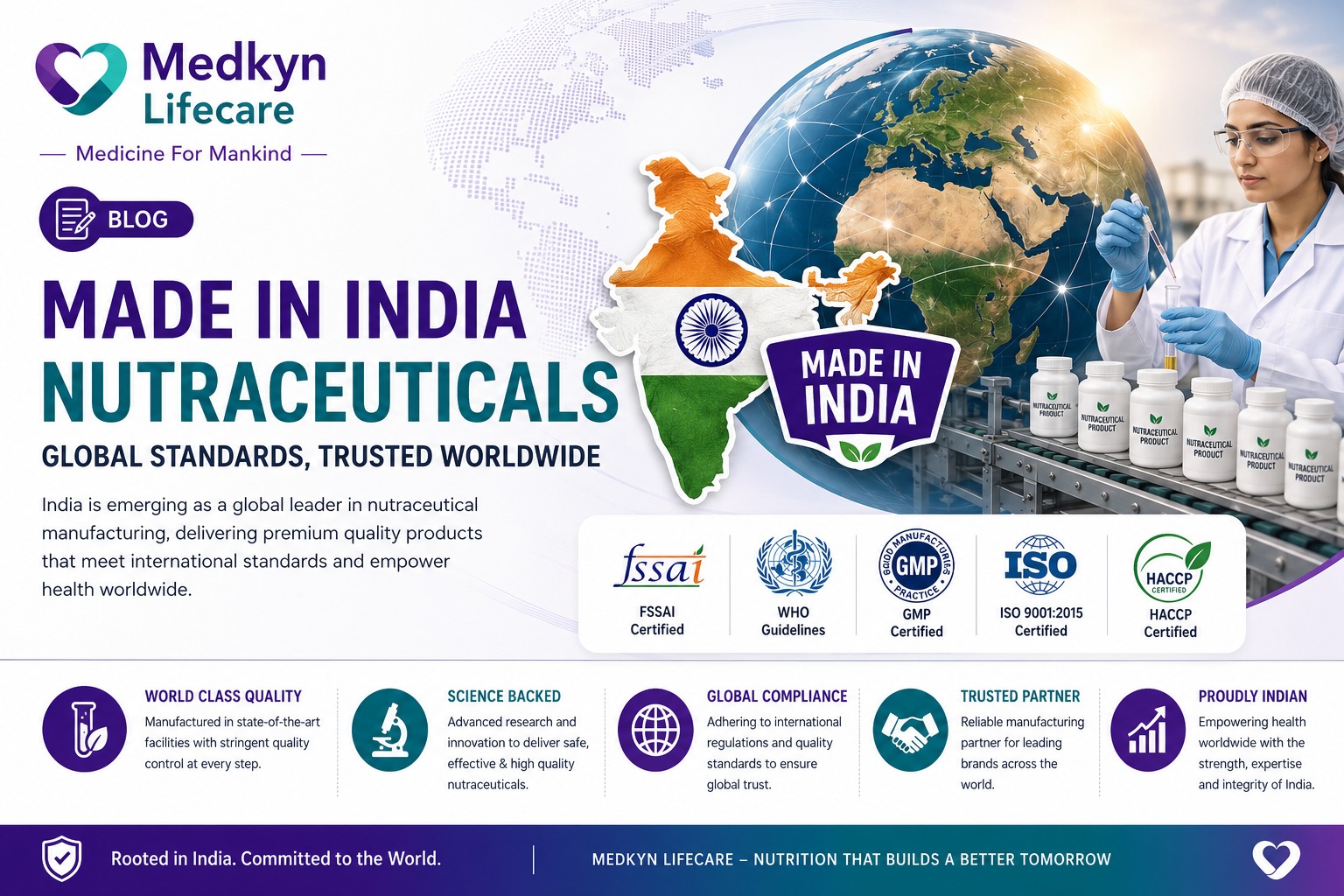
In practice, this means the Vitakyn daily wellness range and the Argikyn women's nutrition range are produced to pharmaceutical-grade process control, not just food-safety minimums. You can review the full list of credentials, with context on what each one covers, on the Medkyn quality and certifications page. For a broader view of how Indian-made nutraceuticals measure up internationally, see our guide to made-in-India nutraceuticals and global standards.
No single logo tells the whole story. The trust signal is a manufacturer that earns and maintains all of them at once.
- FSSAI (Food Safety and Standards Authority of India) is the mandatory food-safety licence covering hygiene, labelling, and permitted ingredients for nutraceuticals.
- WHO-GMP (World Health Organization Good Manufacturing Practice) verifies pharmaceutical manufacturing process, documentation, and batch traceability — and is export-relevant.
- ISO 9001:2015 is a voluntary, industry-agnostic Quality Management System standard focused on consistent processes and continual improvement.
- Each verifies a different layer, so the real trust signal is holding all three together rather than any one alone.
- Medkyn Lifecare, Ahmedabad holds WHO-GMP, FSSAI, ISO 9001:2015, and GMP, applied to both pharma and nutraceutical production.
Frequently asked questions
What is the difference between FSSAI and WHO-GMP?
FSSAI (Food Safety and Standards Authority of India) is a statutory food-safety regulator whose licence is mandatory to legally manufacture and sell nutraceuticals and health supplements in India, covering hygiene, labelling, and permitted ingredients. WHO-GMP (World Health Organization Good Manufacturing Practice) is a pharmaceutical manufacturing-quality endorsement issued by the State Licensing Authority that focuses on processes, documentation, and batch traceability. In short, FSSAI governs what goes into a food product, while WHO-GMP governs how a pharmaceutical product is made.
Is ISO 9001 mandatory for supplements in India?
No. ISO 9001:2015 is a voluntary, international Quality Management System standard. To legally manufacture and sell supplements in India you need an FSSAI licence; ISO 9001:2015 is an additional, voluntary credential that signals a manufacturer runs disciplined, repeatable processes with continual improvement. Many serious manufacturers hold it alongside their mandatory licences.
Which certification matters most when buying supplements?
No single certification tells the whole story, because each verifies something different. For nutraceuticals in India, an FSSAI licence is the mandatory baseline; WHO-GMP shows pharmaceutical-grade manufacturing discipline; and ISO 9001:2015 confirms a managed quality system. The strongest signal is a manufacturer that holds all three together, which is why Medkyn Lifecare maintains FSSAI, WHO-GMP, and ISO 9001:2015 certification.
Does Medkyn Lifecare hold all three certifications?
Yes. Medkyn Lifecare manufactures both pharmaceutical and nutraceutical products at a facility in Ahmedabad, Gujarat, India that holds WHO-GMP, FSSAI, ISO 9001:2015, and GMP certification. The same quality systems apply across its Vitakyn and Argikyn ranges.