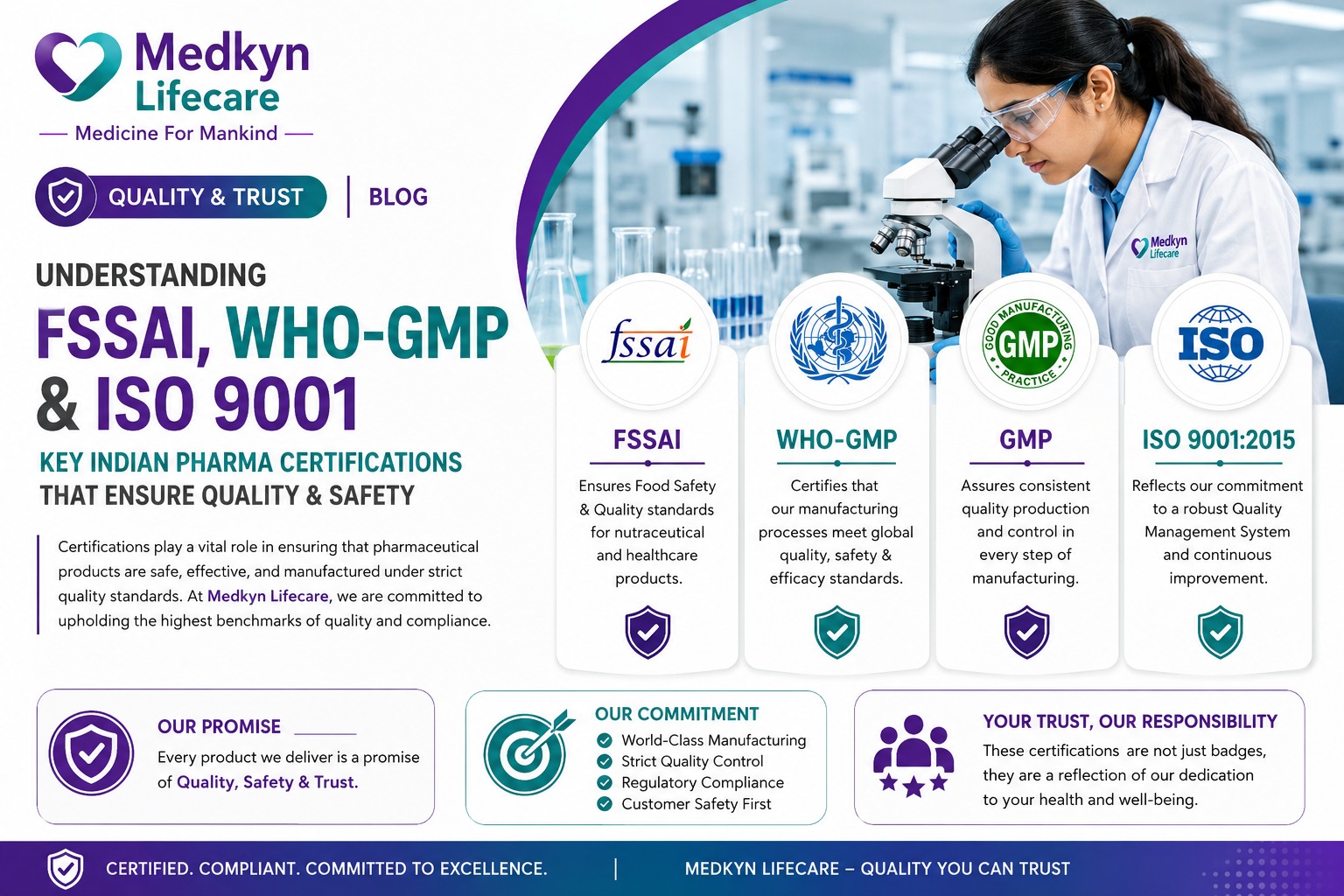
WHO-GMP certification is a manufacturing standard, based on the World Health Organization's Good Manufacturing Practice guidelines, that confirms a pharmaceutical facility produces medicines safely, consistently, and to fully documented quality standards. For anyone sourcing products from India, it is the clearest single signal that a manufacturer can be trusted batch after batch. Medkyn Lifecare manufactures both pharmaceutical and nutraceutical products at a WHO-GMP certified, FSSAI-approved, ISO 9001:2015 facility in Ahmedabad, Gujarat, India.
India supplies an estimated 20% of the world's generic medicines by volume and is often called "the pharmacy of the world." That scale only works because buyers can trust quality, and the credential that underpins that trust is WHO-GMP. If you are a distributor, a hospital procurement lead, a pharmacy chain, or a brand owner looking for a contract manufacturer, understanding what WHO-GMP actually verifies will help you choose a partner with confidence.
What is WHO-GMP certification?
Good Manufacturing Practice (GMP) is a system of processes, procedures, and documentation that ensures a product is consistently produced and controlled to quality standards appropriate to its intended use. WHO-GMP is the version of those guidelines published by the World Health Organization and adopted worldwide as a baseline for pharmaceutical quality.
In India, GMP compliance is a legal requirement under Schedule M of the Drugs and Cosmetics Rules. A WHO-GMP certificate goes a step further: it is issued by the State Licensing Authority (often via the Central Drugs Standard Control Organisation, CDSCO framework) and confirms that a specific facility meets WHO's internationally recognised standard. It is the document buyers and export markets ask for first.
Why does WHO-GMP certification matter?
WHO-GMP matters because medicine quality cannot be confirmed by looking at the finished tablet. You cannot see whether the active ingredient is the correct potency, whether the batch was contaminated, or whether it will stay stable until its expiry date. GMP builds quality into every step instead of trying to test it in at the end.
For distributors and brand owners
A WHO-GMP certified source means consistent products, complete documentation, and far lower regulatory and reputational risk. Certified products are easier to register, easier to sell into tenders, and eligible for export markets that demand the credential.
For hospitals and institutional buyers
Most government and institutional tenders in India require suppliers to demonstrate WHO-GMP compliance. The certificate is effectively a ticket to participate — without it, a manufacturer simply cannot bid for much of the institutional market.
What does a WHO-GMP audit actually check?
A WHO-GMP inspection is rigorous and covers the entire manufacturing chain, not just the final product. Auditors typically verify:
- Premises and equipment — clean-room classifications, air handling, water systems, and validated machinery.
- Raw material control — identity testing and approved-vendor sourcing for every incoming ingredient.
- Documentation — batch manufacturing records that make every batch fully traceable from raw material to dispatch.
- In-process and finished-product testing — quality checks at each stage and release testing against specification.
- Trained personnel and SOPs — qualified staff following written standard operating procedures.
- Stability data — evidence the product holds its quality across its stated shelf life.
How did Medkyn Lifecare achieve WHO-GMP certification?
Medkyn Lifecare, Ahmedabad, built its facility to WHO-GMP requirements from the ground up rather than retrofitting them later. That meant designing controlled manufacturing areas, validating equipment and water systems, establishing an in-house quality control function, and documenting standard operating procedures for every process before commercial production began.
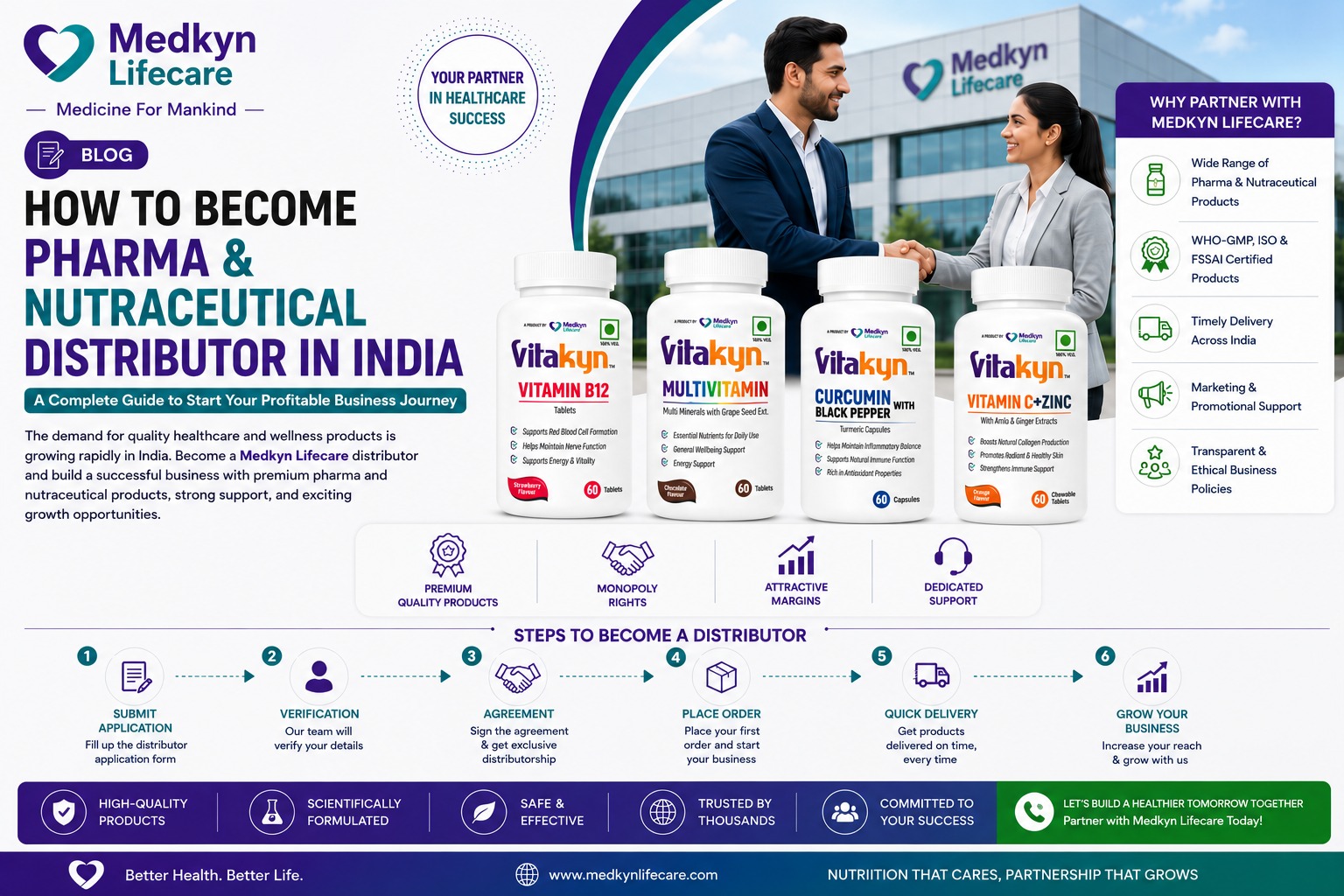
Crucially, Medkyn applies the same WHO-GMP discipline to both its pharmaceutical formulations and its nutraceutical supplements. The Vitakyn daily wellness range and the Argikyn women's nutrition range are produced under the identical quality system that governs its pharmaceutical output — so the supplement on the shelf is held to the same standard as the medicine beside it. You can review the full list of credentials on the Medkyn quality and certifications page.
A certificate on the wall is only as good as the quality culture behind it. WHO-GMP is a daily practice, not a one-time inspection.
What WHO-GMP means for distributors and buyers
When you partner with a WHO-GMP certified manufacturer, you inherit its quality system. Every batch arrives with a Certificate of Analysis, full traceability, and consistent specifications — which translates directly into fewer complaints, easier registrations, and a stronger story to tell your own customers. For B2B buyers comparing suppliers, WHO-GMP should be a non-negotiable starting filter, alongside FSSAI and ISO 9001:2015. To understand how these credentials differ and why they work best together, read our guide to FSSAI vs WHO-GMP vs ISO 9001 certifications, or see how the certificate plays out in practice in third party pharmaceutical manufacturing in Ahmedabad.
- WHO-GMP certification confirms a facility makes products safely and consistently to WHO's Good Manufacturing Practice standard.
- In India, GMP (Schedule M) is mandatory; a WHO-GMP certificate is the internationally recognised, export-grade endorsement.
- A WHO-GMP audit checks premises, raw materials, documentation, testing, trained staff, and stability data — the whole chain.
- Medkyn Lifecare, Ahmedabad is WHO-GMP certified, FSSAI-approved, and ISO 9001:2015 certified, applying one quality system to both pharma and nutraceuticals.
- For distributors and buyers, WHO-GMP means consistency, documentation, tender eligibility, and lower risk.
Frequently asked questions
What does WHO-GMP certification mean?
WHO-GMP certification means a pharmaceutical facility has been audited and confirmed to manufacture products in line with the World Health Organization's Good Manufacturing Practice guidelines — covering quality systems, premises, equipment, documentation, testing, and batch traceability. It assures buyers that every batch is made safely and consistently.
Is WHO-GMP certification mandatory in India?
Compliance with GMP (Schedule M of the Drugs and Cosmetics Rules) is mandatory for licensed pharmaceutical manufacturers in India. A WHO-GMP certificate is an additional, internationally recognised endorsement issued by state drug authorities that is typically required for exports and for institutional and tender supply.
Is Medkyn Lifecare a WHO-GMP certified manufacturer?
Yes. Medkyn Lifecare manufactures both pharmaceutical and nutraceutical products at a WHO-GMP certified, FSSAI-approved, ISO 9001:2015 certified facility in Ahmedabad, Gujarat, India. The same quality systems apply to its Vitakyn and Argikyn ranges.
Why should distributors choose a WHO-GMP certified manufacturer?
A WHO-GMP certified manufacturer gives distributors batch-to-batch consistency, full documentation and Certificates of Analysis, eligibility for tenders and exports, and lower regulatory and reputational risk — which makes products easier to sell to pharmacies, hospitals, and institutional buyers.