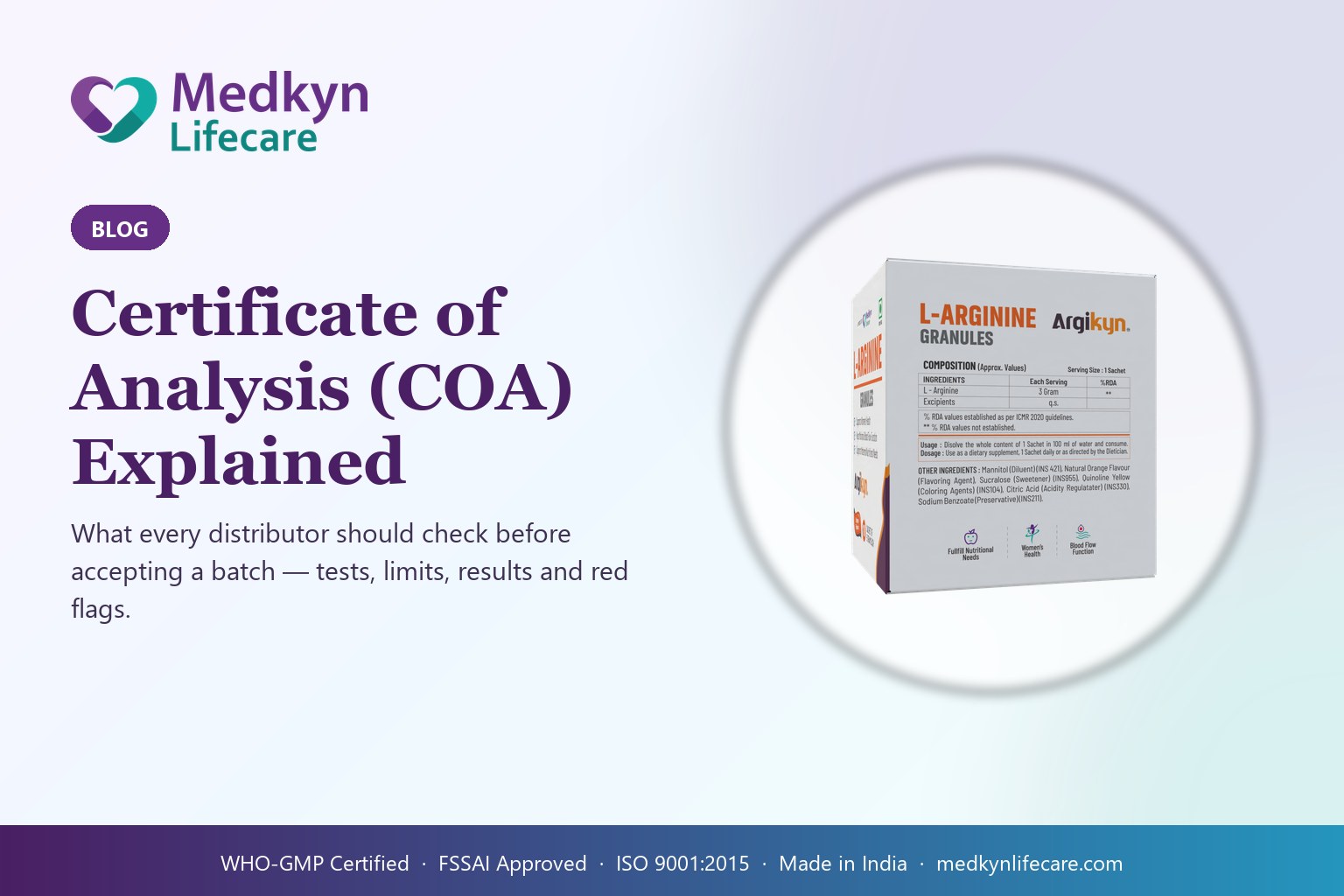
A Certificate of Analysis (COA) is the signed document from a manufacturer's quality control department stating that a specific batch of a product was tested and met its written specification. It lists each test, the acceptance limit, and the actual result. For a pharma or nutraceutical distributor, hospital or brand owner, the COA is the one piece of paper that turns "we make quality products" into evidence — and reading it takes two minutes once you know what to look for.
What a COA is — and what it is not
A COA is batch-specific. It does not say a product is good in general; it says batch number X, manufactured on date Y, was tested against specification Z and passed. It is issued by the manufacturer's Quality Control (QC) laboratory and typically approved by Quality Assurance (QA) before release. Under WHO-GMP, no batch can be dispatched without this release, which is why a manufacturer's willingness to share COAs is a direct signal of whether a real quality system exists.
It is not the same as a WHO-GMP certificate (which certifies the facility), an FSSAI licence (which licenses the business) or a Certificate of Conformance (a simpler statement that the product conforms, without the test data). If someone offers you a "quality certificate" without batch numbers and results, it is not a COA.
Anatomy of a COA
Layouts differ, but every credible COA has the same parts:
- Header: manufacturer's name, address and licence numbers; the document title.
- Product identity: product name, label claim (e.g. "each tablet contains…"), batch number, batch size, manufacturing date, expiry date, and the specification reference.
- Test table: one row per test with three columns — test, specification (limit), result.
- Conclusion: "The batch complies with the specification" (or does not).
- Sign-off: analyst, QC head and QA release signature with dates.
The tests you should expect to see
| Test | What it checks | Typical limit | Applies to |
|---|---|---|---|
| Description | Colour, shape, markings match the standard | "Complies" | All |
| Average weight / weight variation | Each unit contains the intended amount | Within ±5–10% of target | Tablets, capsules, sachets |
| Assay (content of actives) | How much of each active is actually present | Commonly 90–110% or 95–105% of label claim | All |
| Disintegration / dissolution | The tablet or capsule breaks up and releases in a set time | e.g. disintegration ≤ 30 min | Tablets, capsules |
| Loss on drying / moisture | Water content, which affects stability | Product-specific, often ≤ 5% | Tablets, granules |
| Microbial limits | Total bacterial and yeast/mould counts; absence of pathogens (E. coli, Salmonella, S. aureus) | Per pharmacopoeia / FSSAI | All |
| Heavy metals | Lead, arsenic, cadmium, mercury | Per FSSAI contaminant limits | Botanicals, minerals, fish oil |
| Peroxide / anisidine value | Oxidation (rancidity) of the oil | Product-specific | Omega-3 soft gels |
| pH, fill volume, reconstitution | Sachet dissolves and tastes as intended | Product-specific | Granules and sachets |
For nutraceuticals, assay of every declared vitamin and mineral is the test that matters most: it is what proves the composition table on the label is true for the batch in your warehouse.
- Batch number matches the cartons you received.
- Every active on the label has an assay row — none missing.
- Result column shows numbers, not just "complies", for assay and microbiology.
- Results sit inside the limits and are not identical across batches (a sign of copy-paste).
- Signed and dated by QC and QA, on the manufacturer's letterhead with licence numbers.
Reading specification vs result
The specification column is the promise; the result column is the measurement. A calcium tablet with a label claim of 250 mg elemental calcium might show Specification: 90.0–110.0% of label claim and Result: 98.6%. That is a pass with margin. A result of 90.4% is still a pass, but if every batch sits near the bottom of the range you may reasonably ask about the manufacturing overage and stability. Results consistently at exactly 100.0% across batches are, frankly, more suspicious than results that vary a little — real analytical work has scatter.
Manufacturer COA vs third-party COA
Most COAs are issued by the manufacturer's own QC lab, and under WHO-GMP that lab is audited, equipment-calibrated and method-validated. Some buyers additionally request third-party testing from an NABL-accredited laboratory, either for every batch or on a sampling basis. This is common for institutional tenders and for botanicals or fish oil, where contaminant testing is more specialised. A good manufacturer will not object; they may already send certain tests out and will say so on the COA.
Red flags
- No batch number, or a batch number that does not appear on the packs.
- Only "complies" in every result cell, with no numerical values anywhere.
- Actives declared on the label that have no assay row.
- No microbial limits on a product that will be swallowed.
- No signatures, no dates, no letterhead — a Word document with a logo.
- The "manufacturer" on the COA is not the manufacturer on the pack.
- Identical results across three consecutive batches.
How to use COAs in your business
Distributors and stockists: ask for the COA with every delivery and file it against the invoice; hospital and institutional customers will ask for it, and so will an FSSAI or drug inspector. Brand owners using a contract manufacturer: make batch COAs a written condition in the quality agreement, alongside the specification they are tested against. Pharmacies and hospitals: request COAs for any product you buy in volume or supply to vulnerable patients. If a supplier resists, that is your answer.
Medkyn Lifecare's practice
Every batch of Vitakyn and Argikyn products released from our WHO-GMP certified facility in Ahmedabad is tested against its specification and dispatched with a Certificate of Analysis. Serious distributor, hospital and contract-manufacturing enquiries also receive copies of our WHO-GMP, FSSAI and ISO 9001:2015 certificates — the facility-level documents that sit behind every batch-level COA. Our quality page explains the system in full.
Frequently asked questions
What is a Certificate of Analysis (COA)?
A Certificate of Analysis is a signed document from a manufacturer's quality control laboratory stating that a specific batch of a product was tested against its written specification and listing each test, the acceptance limit and the actual result. It is batch-specific and is required for release under WHO-GMP. It is different from a facility certificate such as WHO-GMP or a business licence such as FSSAI.
Who issues a COA?
The manufacturer's Quality Control department performs the tests and prepares the COA, and Quality Assurance approves it before the batch is released. Some buyers additionally commission an independent COA from an NABL-accredited third-party laboratory, especially for institutional tenders or for products such as botanicals and fish oil that need specialised contaminant testing.
What tests should a COA for a supplement include?
At minimum: description, average weight or weight variation, assay of every active declared on the label, disintegration or dissolution for tablets and capsules, moisture or loss on drying where relevant, microbial limits including absence of pathogens, and heavy metals for botanicals, minerals and fish oil. Omega-3 soft gels should also show oxidation values such as peroxide value.
Does Medkyn Lifecare provide a COA with every batch?
Yes. Medkyn Lifecare issues a batch Certificate of Analysis for every Vitakyn and Argikyn product dispatched to distributors, hospitals and institutional buyers, and shares copies of its WHO-GMP, FSSAI and ISO 9001:2015 certificates with genuine B2B and contract-manufacturing enquiries.