A multivitamin is a low-dose combination of vitamins and minerals designed to top up a diet, not replace it. For an adult eating a varied diet with dairy, eggs or meat, fruit and vegetables every day, the evidence for a general benefit is weak. For the far larger group of Indian adults whose diets are cereal-heavy, largely vegetarian and short on vitamin B12, vitamin D, iron, zinc and calcium, a multivitamin at RDA-level doses is a sensible, inexpensive safety net. This guide helps you decide which group you are in — and how to judge a multivitamin by its label.
The honest answer: it depends on your diet
Large trials in well-nourished Western populations have generally found that a daily multivitamin does not reduce heart disease or overall mortality in people who already eat well. That finding gets quoted a lot. What it does not describe is the typical Indian adult diet — which national surveys repeatedly show is high in refined cereals and low in the foods that supply vitamin B12, vitamin D, iron, zinc, riboflavin and calcium. A supplement cannot fix a poor diet, but it can quietly close the gaps a mostly-good one leaves open.
Nutrients Indian diets most often miss
| Nutrient | Why it's short in India | ICMR-NIN 2020 adult RDA |
|---|---|---|
| Vitamin B12 | Found almost only in animal foods; vegetarian and vegan diets provide little | 2.2 mcg |
| Vitamin D | Indoor living, clothing, pollution and skin tone limit synthesis; few dietary sources | 600 IU (15 mcg) |
| Iron | Plant iron absorbs poorly; phytates in cereals block it; women lose iron monthly | 19 mg (men), 29 mg (women) |
| Zinc | Best sources are animal foods; cereal phytates reduce absorption | 17 mg (men), 13.2 mg (women) |
| Calcium | Low dairy intake in many regions; needs vitamin D to be absorbed | 1000 mg |
| Riboflavin (B2) | Low dairy and egg intake | 2.0 mg (men), 1.6 mg (women) |
| Iodine | Depends on iodised salt use; deficiency persists in pockets | 140 mcg |
Look at the pattern: most of these are nutrients that come from milk, eggs, meat and fish. That is why the question "do I need a multivitamin?" in India usually turns into "how much of those foods do I actually eat?"
Who is most likely to benefit
- Vegetarians and vegans — for B12, zinc, iron and often vitamin D.
- Adults over 50 — stomach acid falls with age, reducing B12 absorption; appetite and food variety often narrow.
- Women of reproductive age — iron and folate needs are higher; a multivitamin is a baseline, though iron-deficiency anaemia needs a dedicated iron product on a doctor's advice.
- People on restricted or repetitive diets — dieting, shift work, hostel or tiffin food, or simply eating the same three meals every day.
- Those recovering from illness or with reduced appetite.
- Heavy drinkers and smokers — both deplete B-vitamins and vitamin C.
Who probably doesn't need one
Adults who eat dairy, eggs or meat most days, three or more servings of vegetables and fruit, some nuts or legumes, and get regular sun. Also anyone already taking targeted supplements — a multivitamin on top can push some nutrients (vitamin A, iron, zinc) above sensible totals. And no multivitamin substitutes for a diagnosed deficiency: confirmed low B12 or vitamin D needs a therapeutic dose from a doctor, not a 100% RDA tablet.
- A multivitamin is insurance for gaps, not a treatment. It helps most when the diet is cereal-heavy and low in animal foods.
- In India the usual gaps are B12, vitamin D, iron, zinc and calcium.
- A well-designed multivitamin sits at or below 100% RDA per nutrient — that is FSSAI's rule, and it is safe for daily use.
- Judge it by the composition table: nutrient forms, doses and % RDA, not the front-of-pack claims.
- A diagnosed deficiency needs a targeted product and a doctor.
What a well-designed multivitamin looks like
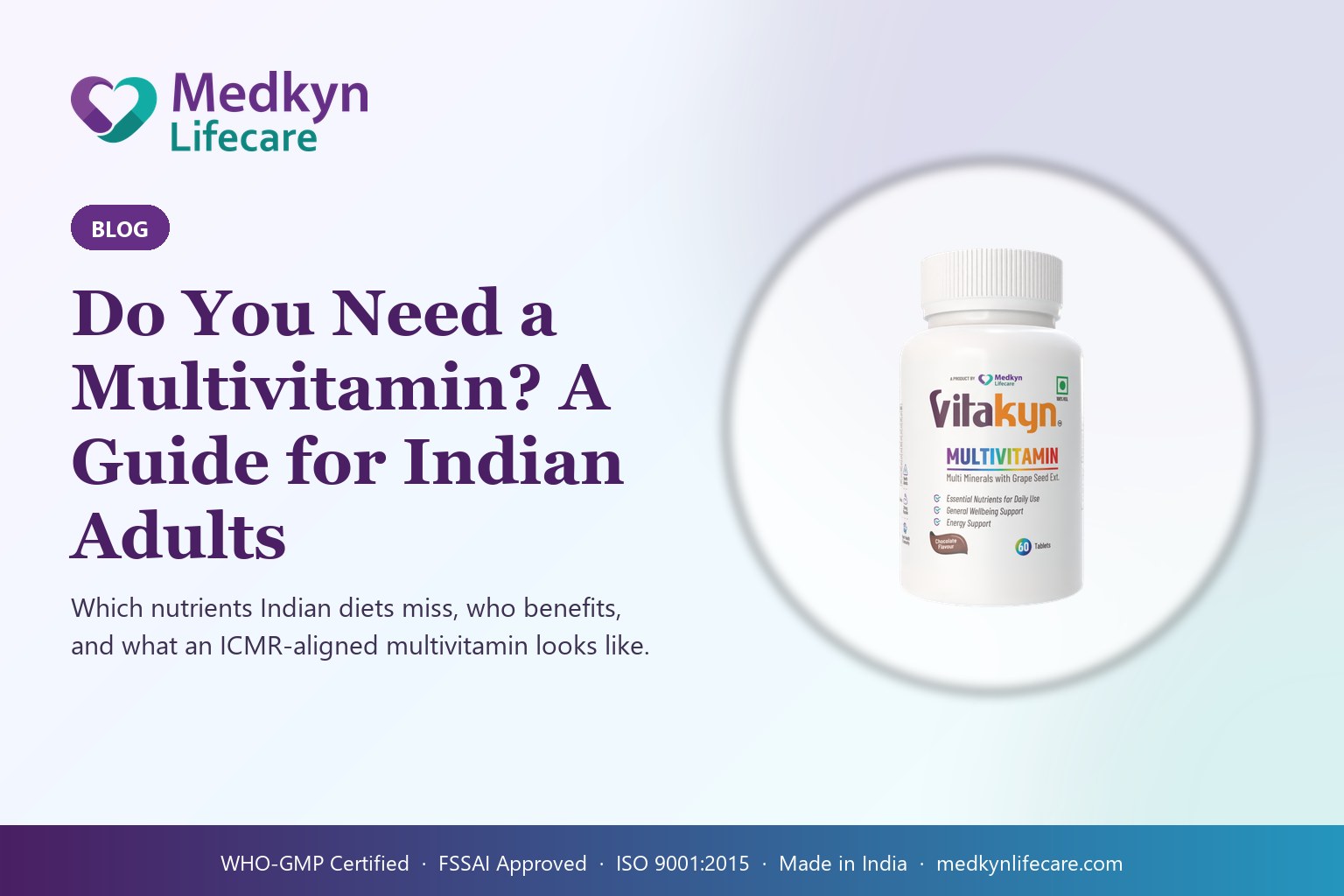
Use Vitakyn Multivitamin with Grape Seed Extract as a reference point — one tablet, 24 nutrients:
- Vitamins at 100% RDA: A (800 mcg), D (600 IU), B12 (2.2 mcg), B5 (5 mg), K1 (55 mcg).
- B-complex at 48–83%: B1, B2, B3, B6, B7 and B9 (folate 200 mcg).
- Minerals: calcium 250 mg, magnesium 66 mg, zinc 11 mg, iron 3.7 mg, iodine 140 mcg, selenium 40 mcg, chromium, manganese, copper and molybdenum.
- Plus 70 mg grape seed extract — a source of oligomeric proanthocyanidins (OPCs), a polyphenol group studied for antioxidant activity.
Notice what is not there: no megadoses, no "1000% of daily value" on any line. A multivitamin has to fit alongside food, and the Indian regulatory ceiling of one RDA per nutrient is a feature, not a limitation. Notice also that iron is modest (3.7 mg) — a deliberate choice, since men and post-menopausal women should not take high iron daily, and women with anaemia need a dedicated product.
Multivitamin vs single-nutrient supplements
The two are not rivals. A multivitamin covers breadth; a single-nutrient product covers depth. If a blood test shows vitamin B12 at the low end, a B12 tablet is the direct answer. If bone density or dietary calcium is the concern, a calcium-D3-K2 formula provides four times the calcium a multivitamin can fit in one tablet. Many people sensibly take a multivitamin as the base and add one targeted product for their known gap — but check the totals so the two do not overlap heavily on the same nutrient.
How to take a multivitamin
One tablet daily with a meal. Fat-soluble vitamins (A, D, E, K) absorb better with dietary fat, and taking minerals with food avoids stomach upset. Morning or lunchtime is easiest to remember; taking B-vitamins late at night keeps some people awake. Do not double up if you miss a day. Keep the bottle cool, dry and out of children's reach — iron-containing tablets can be dangerous to small children in quantity.
Reading the label before you buy
Check the composition table for the nutrient forms (cholecalciferol for D, cyanocobalamin or methylcobalamin for B12), % RDA per line, the "other ingredients" list, both FSSAI licence numbers, and the vegetarian mark if that matters to you. Our guide to reading a supplement label in India goes line by line.
Frequently asked questions
Should I take a multivitamin every day?
If your diet is cereal-heavy, largely vegetarian or repetitive, a daily multivitamin at RDA-level doses is a reasonable safety net for nutrients Indian diets often miss — B12, vitamin D, iron, zinc and calcium. If you eat dairy, eggs or meat most days with plenty of fruit and vegetables, the benefit is small. A multivitamin never replaces treatment for a diagnosed deficiency.
What is the best time to take a multivitamin?
With a meal, preferably breakfast or lunch. Fat-soluble vitamins A, D, E and K are absorbed better alongside dietary fat, minerals are gentler on the stomach with food, and taking B-vitamins earlier in the day avoids the mild alertness some people notice at night. Consistency matters more than the exact hour.
Is Vitakyn Multivitamin vegetarian?
Yes. Vitakyn Multivitamin with Grape Seed Extract is a 100% vegetarian, chocolate-flavoured tablet supplying 24 vitamins and minerals at or below 100% of the ICMR-NIN 2020 RDA, plus 70 mg grape seed extract. It comes in a pack of 60 tablets and is manufactured under WHO-GMP and FSSAI standards for Medkyn Lifecare, Ahmedabad.
Can I take a multivitamin together with a calcium or B12 supplement?
Usually yes, but check the totals. A multivitamin typically provides only a fraction of the calcium RDA (Vitakyn Multivitamin has 250 mg), so adding a dedicated calcium-D3 product is common. Adding a B12 tablet on top of a multivitamin that already has 100% RDA is generally safe because excess B12 is excreted, but a diagnosed deficiency should be dosed by a doctor.