Calcium builds and maintains your bones, but your body can only absorb it properly when it has enough vitamin D3 — and despite India's abundant sunshine, published Indian studies report that vitamin D deficiency is widespread across age groups. Low calcium intake makes the problem worse. This guide explains why so many Indians fall short, how D3, K2-7, and magnesium work together, and how Vitakyn Calcium D3 by Medkyn Lifecare, Ahmedabad, is formulated so the calcium you take is actually absorbed and put to use.
If you have ever wondered why a person can live in a sunny country and still be told they are "vitamin D deficient," you are asking the right question. Calcium and vitamin D3 are a team, and in India a surprising number of people are short on both. Understanding why — and what genuinely helps — is the first step to looking after your bones for the long term.
Why are so many Indians deficient in calcium and vitamin D3?
It seems like a contradiction: India gets plenty of sun, yet numerous published Indian studies report that vitamin D deficiency is very common across children, adults, and older people alike. The explanation lies in how vitamin D is actually made and what we eat.
Less sun reaches the skin than you'd think
Your skin makes vitamin D3 when sunlight (specifically UVB) hits it. But modern life gets in the way: indoor work and study, staying out of the harsh midday sun, full-coverage clothing, sunscreen, and urban air pollution that filters UVB. Naturally darker skin also contains more melanin, which means it needs more sun exposure to produce the same amount of vitamin D. Put together, many people simply do not make enough.
Diets are often low in both nutrients
Very few foods are naturally rich in vitamin D, and typical Indian diets provide little of it. Calcium intake is frequently low too, especially where dairy consumption is limited. When both the sunshine pathway and the food pathway fall short, deficiency follows.
Why does calcium need vitamin D3?
This is the heart of the matter. Vitamin D3 (cholecalciferol) is what allows your gut to absorb calcium. You can eat or supplement plenty of calcium, but without enough vitamin D3, much of it simply passes through without being absorbed. The two are not optional companions — they are functionally linked.
When vitamin D levels are low, the body absorbs calcium poorly and may pull calcium from the skeleton to keep blood levels steady, which works against bone health over time. That is why taking calcium together with vitamin D3 is so commonly recommended: it is the difference between calcium that is absorbed and calcium that is wasted. For a wider look at how nutrient gaps show up in everyday health, see our guide to vitamin B12 deficiency in India.
What do K2-7 and magnesium do for calcium absorption?
Getting calcium absorbed is only half the job. The other half is getting it to the right place — your bones — and that is where supporting nutrients matter.
Vitamin K2-7 directs calcium into bone
Vitamin K2 as menaquinone-7 (MK-7), often labelled K2-7, helps guide calcium into the bone matrix rather than letting it deposit in soft tissue and arteries. In other words, it helps put the absorbed calcium where it belongs.
Magnesium and zinc support the system
Magnesium is a cofactor the body needs to activate vitamin D and is involved in bone metabolism, so low magnesium can blunt the benefit of vitamin D itself. Zinc also contributes to normal bone health. Together, these supporting nutrients explain why modern bone-health formulas combine calcium and D3 with K2-7, magnesium, and zinc rather than offering calcium alone.
Calcium is only useful if your body can absorb it and send it to your bones — which is exactly what D3, K2-7, and magnesium make possible.
How is Vitakyn Calcium D3 formulated?
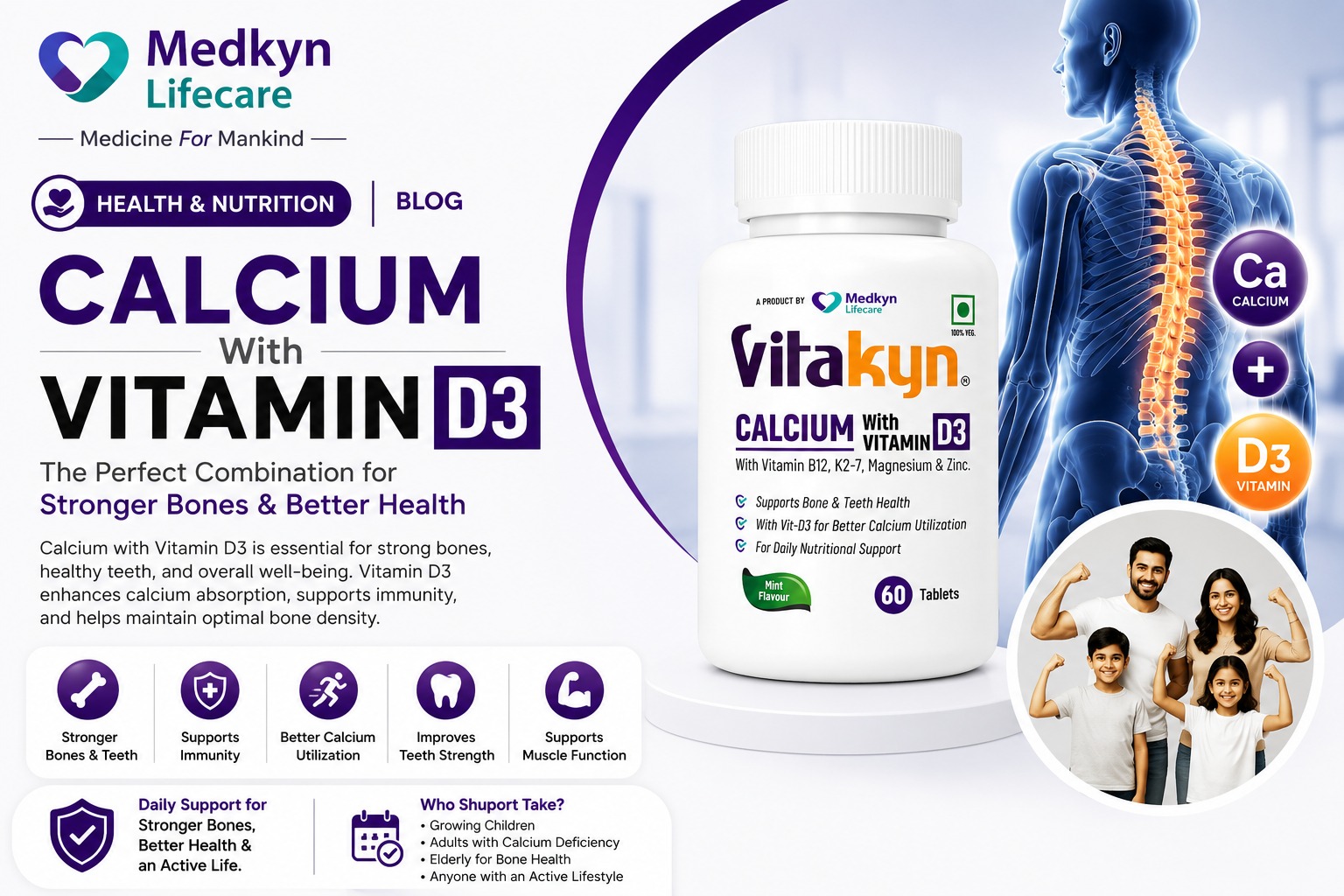
Vitakyn Calcium with Vitamin D3 + B12 + K2-7 + Magnesium + Zinc is built around this absorption-first logic. Rather than supplying calcium in isolation, it pairs calcium with the nutrients that help the body absorb it and route it to the skeleton:
- Calcium — the core mineral for building and maintaining bone.
- Vitamin D3 (cholecalciferol) — enables calcium absorption from the gut.
- Vitamin K2-7 (MK-7) — helps direct calcium into bone rather than soft tissue.
- Magnesium — a cofactor for vitamin D activation and bone metabolism.
- Zinc — supports normal bone health.
- Vitamin B12 — added to support everyday wellness.
It comes as a vegetarian, mint-flavoured tablet in a pack of 60 tablets, designed for daily bone-health support. It is made by Medkyn Lifecare, Ahmedabad, at a WHO-GMP certified, FSSAI-approved, ISO 9001:2015 certified facility — the same quality system that governs the rest of the Vitakyn daily wellness range. You can browse the full lineup on our products page.
How can you improve calcium and vitamin D levels?
A few practical, sensible steps go a long way:
- Get some safe sunlight on your skin where practical, while avoiding sunburn.
- Include calcium-rich foods such as dairy, ragi, sesame, and leafy greens.
- Consider a well-formulated calcium with vitamin D3 supplement, particularly if your diet or sun exposure is limited.
Importantly, get your vitamin D level tested and consult a doctor for the right dose — especially if you are older, pregnant, or have existing health conditions. A blood test takes the guesswork out and helps your doctor recommend the dose that is right for you. For broader guidance on choosing supplements, see our overview of the best supplements for women's health in India, and you can read the plain-language consumer fact sheet on vitamin D from the NIH Office of Dietary Supplements or browse the underlying research on PubMed.
- Vitamin D3 enables calcium absorption — without enough D3, dietary or supplemental calcium is poorly absorbed.
- Despite plenty of sun, published Indian studies report that vitamin D deficiency is widespread due to indoor lifestyles, clothing, pollution, darker skin, and low dietary intake.
- K2-7 helps direct calcium into bone, while magnesium activates vitamin D and zinc supports bone health.
- Vitakyn Calcium D3 by Medkyn Lifecare, Ahmedabad, combines calcium with D3, B12, K2-7, magnesium and zinc — vegetarian, mint, 60 tablets.
- Get your vitamin D tested and consult a doctor for dosing, especially with existing conditions.
Frequently asked questions
Why are Indians vitamin D deficient despite sunlight?
Despite abundant sunshine, published Indian studies report that vitamin D deficiency is very common across age groups. Indoor lifestyles, time spent away from midday sun, covering clothing, sunscreen, air pollution, and naturally darker skin (which needs more sun exposure to make vitamin D) all reduce how much the body produces. Low dietary intake of vitamin D and calcium adds to the gap.
Should I take calcium and vitamin D3 together?
Vitamin D3 (cholecalciferol) is needed for the body to absorb calcium from the gut. Without enough vitamin D3, dietary or supplemental calcium is poorly absorbed, so the two are commonly taken together so the calcium can actually be used. Get your vitamin D tested and consult a doctor for the right dose, especially if you have existing health conditions.
What is K2-7 and why is it added to calcium?
K2-7 is vitamin K2 as menaquinone-7 (MK-7). It helps direct calcium into bone rather than letting it deposit in soft tissue and arteries. Adding K2-7 alongside calcium and vitamin D3 supports the goal of getting calcium to where it is useful — the skeleton — which is why combination formulas often include it together with magnesium and zinc.
Is Vitakyn Calcium D3 vegetarian?
Yes. Vitakyn Calcium with Vitamin D3, B12, K2-7, Magnesium and Zinc is a vegetarian, mint-flavoured tablet supplied in a pack of 60 tablets, formulated by Medkyn Lifecare for bone health. As with any supplement, get your vitamin D tested and consult a doctor for dosing guidance.