Vitamin B12 (cobalamin) is an essential nutrient your body needs to make healthy red blood cells, keep nerves working, and build DNA. Because it occurs naturally almost only in animal-derived foods, vegetarians and vegans are at high risk of running low — and since vegetarian diets are very common across India, B12 deficiency is widespread here. Medkyn Lifecare, the Ahmedabad-based maker of the Vitakyn wellness range, formulated Vitakyn Vitamin B12 chewable tablets specifically to help people maintain healthy B12 levels.
Vitamin B12 deficiency is one of those problems that builds quietly. The early symptoms — feeling tired, a bit foggy, slightly breathless — are so easy to blame on a busy life that many people live with low B12 for years before anyone tests for it. This guide explains what B12 does, why deficiency is so common in India, the symptoms to watch for, what causes it, and the practical steps you can take to fix it.
What is vitamin B12 and why is it important?
Vitamin B12, also called cobalamin, is a water-soluble vitamin that your body cannot make on its own. It plays three jobs that keep you functioning every day: forming healthy red blood cells that carry oxygen, supporting the nervous system by helping maintain the protective sheath around your nerves, and assisting in DNA synthesis as cells divide and renew.
When B12 runs low, all three of these processes start to falter. Red blood cells become large and ineffective, nerves can misfire, and you feel the effects as fatigue, tingling, and trouble thinking clearly. The NIH Office of Dietary Supplements describes B12 as essential for these very functions — which is why a shortage shows up across the body rather than in one place.
Why is vitamin B12 deficiency so common in India?
The single biggest reason is diet. Vitamin B12 occurs naturally almost only in animal-derived foods — meat, fish, eggs, and dairy. Plant foods do not reliably contain it. India has one of the world's highest shares of vegetarian diets, so a large part of the population gets little or no B12 from food.
This shows up clearly in the research. Multiple published Indian studies report B12 deficiency to be common across age groups, and consistently more so among those following vegetarian and vegan diets. You can browse this body of evidence on PubMed. The pattern is consistent enough that, for many vegetarians in India, low B12 is the expected baseline rather than the exception.
What are the symptoms of vitamin B12 deficiency?
Because B12 affects both your blood and your nerves, the symptoms are wide-ranging. They also develop slowly, which is exactly why they are so often missed.
Common early symptoms
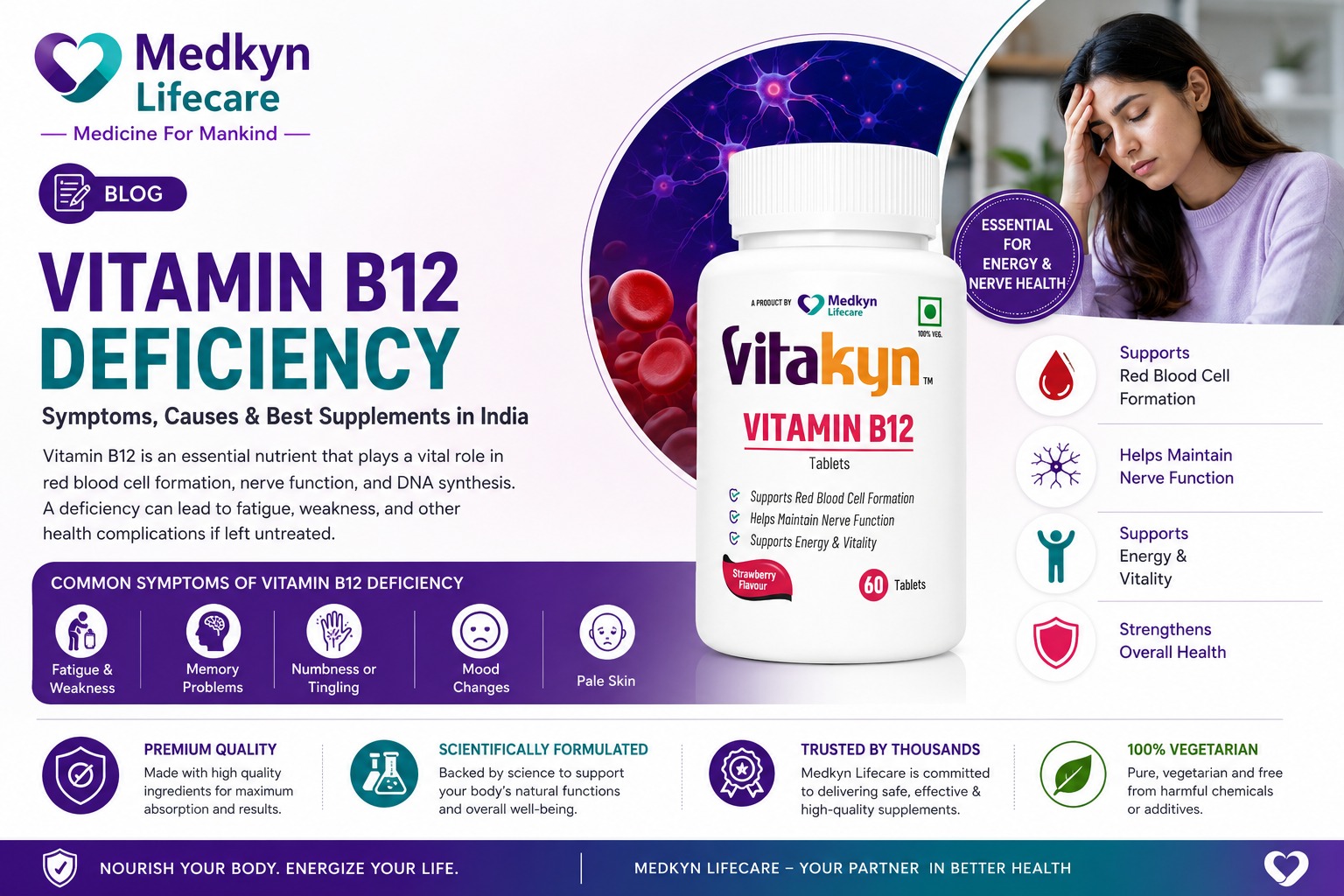
- Fatigue and weakness — a persistent, unexplained tiredness that rest does not fix.
- Tingling or numbness in the hands and feet, a sign of nerve involvement (neuropathy).
- Pale skin and breathlessness, reflecting fewer effective red blood cells.
- Glossitis — a sore, smooth, or swollen tongue.
- Poor concentration and memory, often described as brain fog.
- Mood changes, including low mood or irritability.
Why it matters to act early
Left untreated, severe or long-term B12 deficiency can lead to megaloblastic anaemia and, in serious cases, irreversible nerve damage. The encouraging news is that when caught early, deficiency is very treatable — which is why recognising the signs and getting tested matters.
What causes low vitamin B12?
There are two broad reasons B12 runs low: you are not taking enough in, or your body is not absorbing what you do take in.
- Low dietary intake — the most common cause in India, driven by vegetarian and vegan diets that contain little natural B12.
- Poor absorption — even with enough in the diet, the body may not absorb B12 well. This can result from low intrinsic factor (a protein needed for absorption), increasing age, certain gut conditions, and long-term use of some medicines such as metformin or proton-pump inhibitors (PPIs).
Understanding which cause applies to you matters, because the fix is different. A dietary shortfall responds well to supplements; an absorption problem may need medical assessment and a different approach.
How can you fix a vitamin B12 deficiency?
The good news is that B12 deficiency is one of the more straightforward nutritional problems to correct. A combination of testing, diet, and supplementation usually does the job.
Get tested and talk to a doctor
Because the symptoms overlap with so many other conditions, the only reliable way to confirm low B12 is a blood test. If you suspect a deficiency — especially if you are vegetarian or have ongoing fatigue or tingling — get your B12 levels tested and consult a doctor. Supplements support healthy levels, but they do not replace medical care for severe or absorption-related deficiency, which a doctor may treat with B12 injections.
Improve your dietary B12 where you can
For those who eat them, dairy and eggs provide some B12, and many people benefit from fortified foods. But for committed vegetarians and vegans, diet alone is often not enough to close the gap — which is where a daily supplement becomes the practical answer.
Use a daily B12 supplement
A daily supplement is a simple, effective way to raise and maintain B12 levels when diet falls short. Vitakyn Vitamin B12 is designed for exactly this: 60 chewable tablets in a strawberry flavour, vegetarian, formulated to support nerve function and red blood cell formation. The chewable format makes it easy to take consistently, and the formulation is well suited to vegetarians who cannot get enough B12 from food. You can see it alongside the rest of the Vitakyn daily wellness range.
Vitakyn Vitamin B12 is made by Medkyn Lifecare, Ahmedabad, at a WHO-GMP certified, FSSAI-approved, ISO 9001:2015 facility — so the quality system behind the supplement matches the standard applied to pharmaceutical production.
B12 deficiency builds quietly over years, but it is one of the most fixable nutrient gaps once you know to look for it.
If you are thinking about your wider nutrition, it helps to see how B12 fits alongside other commonly low nutrients in India. Our guide to calcium and vitamin D3 deficiency in India covers another widespread gap, and our overview of the best supplements for women's health in India puts several of these nutrients in context.
- Vitamin B12 (cobalamin) is essential for red blood cells, nerve function, and DNA synthesis.
- It comes almost only from animal-derived foods, so vegetarians and vegans are at high risk — and B12 deficiency is widespread in India.
- Watch for fatigue, tingling or numbness, pale skin, breathlessness, a sore tongue, and brain fog; untreated, it can cause anaemia and nerve damage.
- Causes are low dietary intake or poor absorption (age, gut conditions, metformin/PPI use).
- Get tested, consult a doctor, and consider a daily supplement like vegetarian Vitakyn Vitamin B12 chewables to support healthy levels.
Frequently asked questions
What are the first signs of B12 deficiency?
Early signs of vitamin B12 deficiency are often subtle and easy to miss — persistent tiredness or weakness, breathlessness, a pale complexion, tingling or numbness in the hands and feet, a sore or smooth tongue, and trouble concentrating or remembering things. Because these symptoms develop slowly, a blood test is the only reliable way to confirm low B12.
Why are vegetarians at risk of B12 deficiency?
Vitamin B12 occurs naturally almost only in animal-derived foods such as meat, fish, eggs and dairy. People following vegetarian or vegan diets get little or no B12 from food, so over time their stores run low. Since vegetarian diets are very common in India, published Indian studies report B12 deficiency to be widespread, especially among vegetarians.
Can chewable B12 tablets fix a deficiency?
For deficiency caused by low dietary intake, a daily B12 supplement such as Vitakyn Vitamin B12 chewable tablets can help raise and maintain healthy B12 levels. The chewable format makes daily use easy. However, severe or long-standing deficiency, or deficiency caused by an absorption problem, should be assessed by a doctor, who may recommend testing or B12 injections alongside supplementation.
Is Vitakyn Vitamin B12 vegetarian?
Yes. Vitakyn Vitamin B12 is a vegetarian chewable tablet in a strawberry flavour, formulated to support nerve function and red blood cell formation. It is well suited to vegetarians and vegans who cannot obtain enough B12 from diet alone. It is made by Medkyn Lifecare at a WHO-GMP certified, FSSAI-approved, ISO 9001:2015 facility in Ahmedabad.