India's pharmaceutical and nutraceutical channel runs on a handful of partnership models. In a PCD (Propaganda-cum-Distribution) franchise, a company gives you monopoly marketing rights for its brands in a territory, and you sell to doctors and chemists on your own account. In a distributorship or stockist arrangement, you buy stock at a margin and supply retailers, hospitals and institutions, while the company handles brand-building. Both are legitimate routes into the industry; they suit different budgets, skills and appetites for risk. This guide lays them side by side.
The channel, from factory to pharmacy
A typical Indian pharma or nutraceutical supply chain has four or five layers: manufacturer → C&F agent (carrying and forwarding) → super-stockist → distributor / stockist → retailer (chemist, pharmacy chain, hospital). Nutraceuticals sold as FSSAI foods often use a shorter chain — manufacturer → distributor → retailer or online marketplace — because they do not require a drug licence at each step. The PCD model sits alongside this chain rather than inside it: the franchisee is effectively the company's marketing arm in a district.
The models, side by side
| PCD franchise | Distributor / stockist | Super-stockist / C&F | |
|---|---|---|---|
| What you get | Monopoly marketing rights for the company's brands in a territory; promotional material; products at net rates | Stock at a fixed margin; supply rights to retailers in an area, usually non-exclusive | Regional warehouse role; supplies distributors; paid a commission or thin margin |
| Who builds demand | You — visiting doctors and chemists | The company's sales team and marketing; you fulfil | The company |
| Typical starting investment | Lower — often the cost of an initial order plus a vehicle and samples | Moderate — stock holding plus a warehouse and delivery capacity | Higher — space, staff, working capital for large inventories |
| Gross margin | Highest on paper, because you buy at net rate and sell at retailer price; you fund all promotion | Fixed, modest percentage on MRP (commonly high single digits to low teens for pharma; often higher for nutraceuticals) | Lowest percentage, highest volume |
| Licences | Wholesale drug licence (Form 20B/21B) for pharma; FSSAI licence for nutraceuticals; GST | Same | Same, at larger scale |
| Best for | People with doctor and chemist relationships and selling skill | People with logistics, credit management and retailer coverage | Established distribution houses |
PCD franchise: how it really works
The company supplies products under its own brand names at a net rate and gives you exclusive rights for a territory — a district, a city, sometimes a state. You then promote those brands to doctors (for prescription products) or to chemists and retailers (for OTC and nutraceuticals), take orders, and earn the difference between net rate and the price the retailer pays. The company typically provides visual aids, samples, reminder cards and sometimes a minimum-order commitment in return for monopoly rights.
Advantages: low entry cost, high margin per unit, freedom to run your own business under an established brand. Risks: you fund every promotional rupee; if the brand is weak or the company appoints another party in your territory, your investment evaporates. The quality of the manufacturer — WHO-GMP certification, consistent supply, batch documentation — determines whether doctors keep prescribing.
Distributorship and stockist: how it really works
You buy stock from the company or its super-stockist at an agreed margin, hold it, and supply chemists, pharmacy chains, hospitals and institutional buyers in your area on credit terms. Demand comes from the company's own marketing, doctor promotion or consumer advertising; your job is availability, service and collections. Margins are lower per unit but you sell many more units across many more products, and you are not paying for promotion.
Advantages: predictable margins, demand generated by the brand owner, portfolio can include several companies. Risks: working capital tied up in stock and receivables; expiry and returns management; thin margins on slow-moving lines. The critical decisions are which brands to carry and how much credit to extend.
- PCD = you market, you earn the spread, you carry promotional risk. Suits sellers with doctor and chemist networks.
- Distributorship = you stock and supply, the company markets, you earn a fixed margin. Suits operators with logistics and credit discipline.
- Nutraceuticals need an FSSAI licence; pharmaceuticals need a wholesale drug licence (20B/21B). Both need GST.
- Choose the manufacturer before the model — certifications, documentation and supply reliability decide your income either way.
- Get territory, margin, credit, returns and exclusivity in writing.
Licences and paperwork you will need
- For pharmaceuticals: a wholesale drug licence in Form 20B and 21B from the State Drug Control department, which requires premises of the prescribed size, refrigeration where applicable, and a registered pharmacist or an experienced person as competent staff.
- For nutraceuticals and health supplements: an FSSAI registration or licence (State or Central depending on turnover and reach), because these are regulated as foods. No drug licence is needed to distribute FSSAI products — one reason nutraceutical distributorships are easier to start.
- Both: GST registration, a current account, and usually a signed distributor or franchise agreement covering territory, margins, credit period, returns and expiry policy.
Margins: what to expect
Numbers vary by company and category, so treat these as orientation only. In pharma, retailer margins on MRP are broadly around 20% and distributor margins around 8–10%, set by long-standing trade practice. In nutraceuticals, which are not price-controlled and are often sold on a company-defined trade scheme, distributor margins are frequently higher and more negotiable, and online marketplaces add a parallel channel. PCD net rates are quoted per product; the spread to retailer price can be large, but every visual aid, sample and doctor visit comes out of it. Ask for the net margin after schemes, freight and expiry returns, not the headline percentage.
Questions to ask before you sign
- Is the manufacturer WHO-GMP certified, and can I see the certificate and a recent batch COA?
- Is my territory exclusive, and how is that enforced?
- What is the credit period, and what happens to near-expiry and damaged stock?
- What is the minimum order, and is there a minimum annual commitment?
- Who handles doctor or consumer promotion, and what marketing support is provided?
- What is the order-to-delivery lead time, and the fill rate on repeat orders?
- Which products are consistently in stock — and which are launched but rarely available?
Where Medkyn Lifecare fits
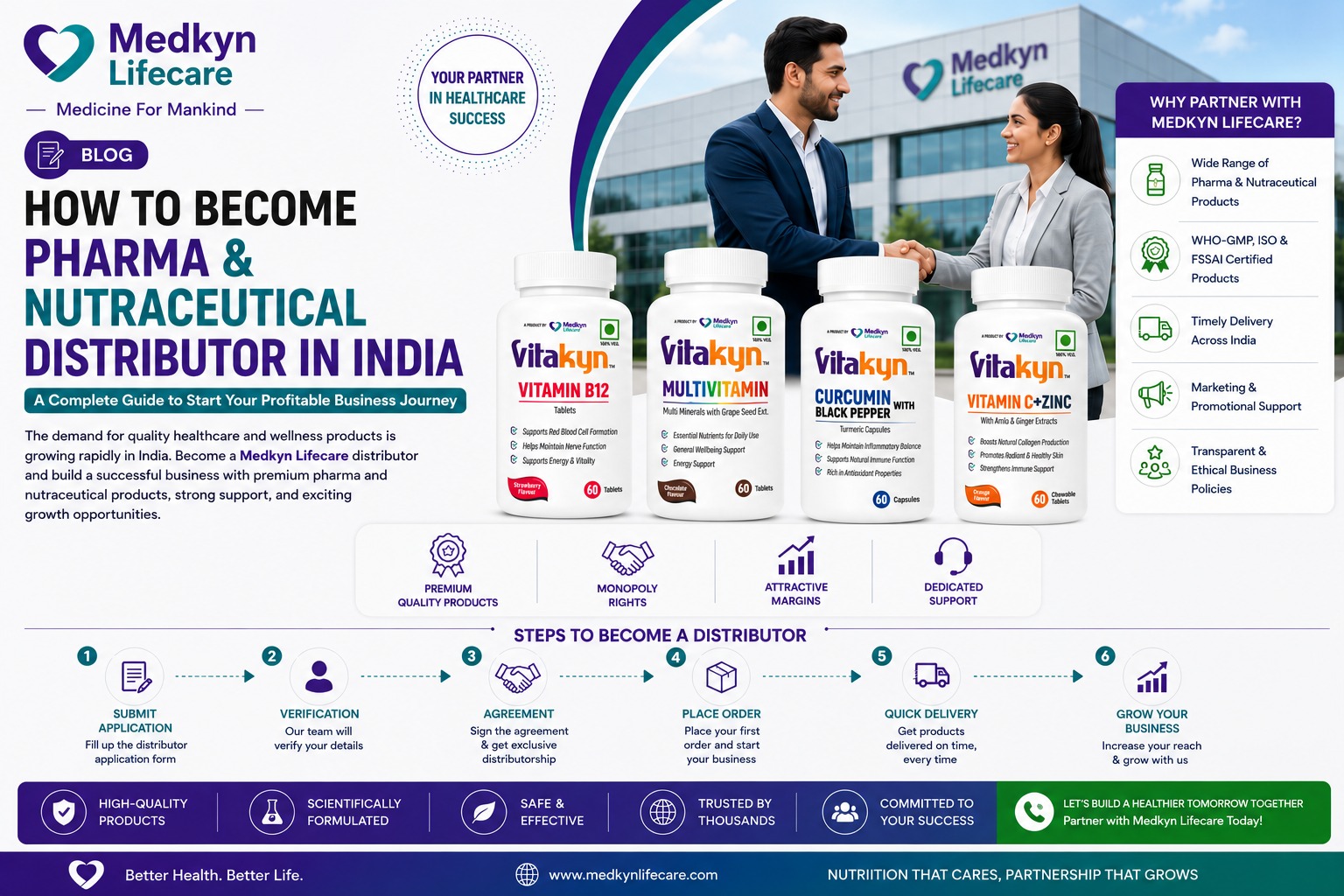
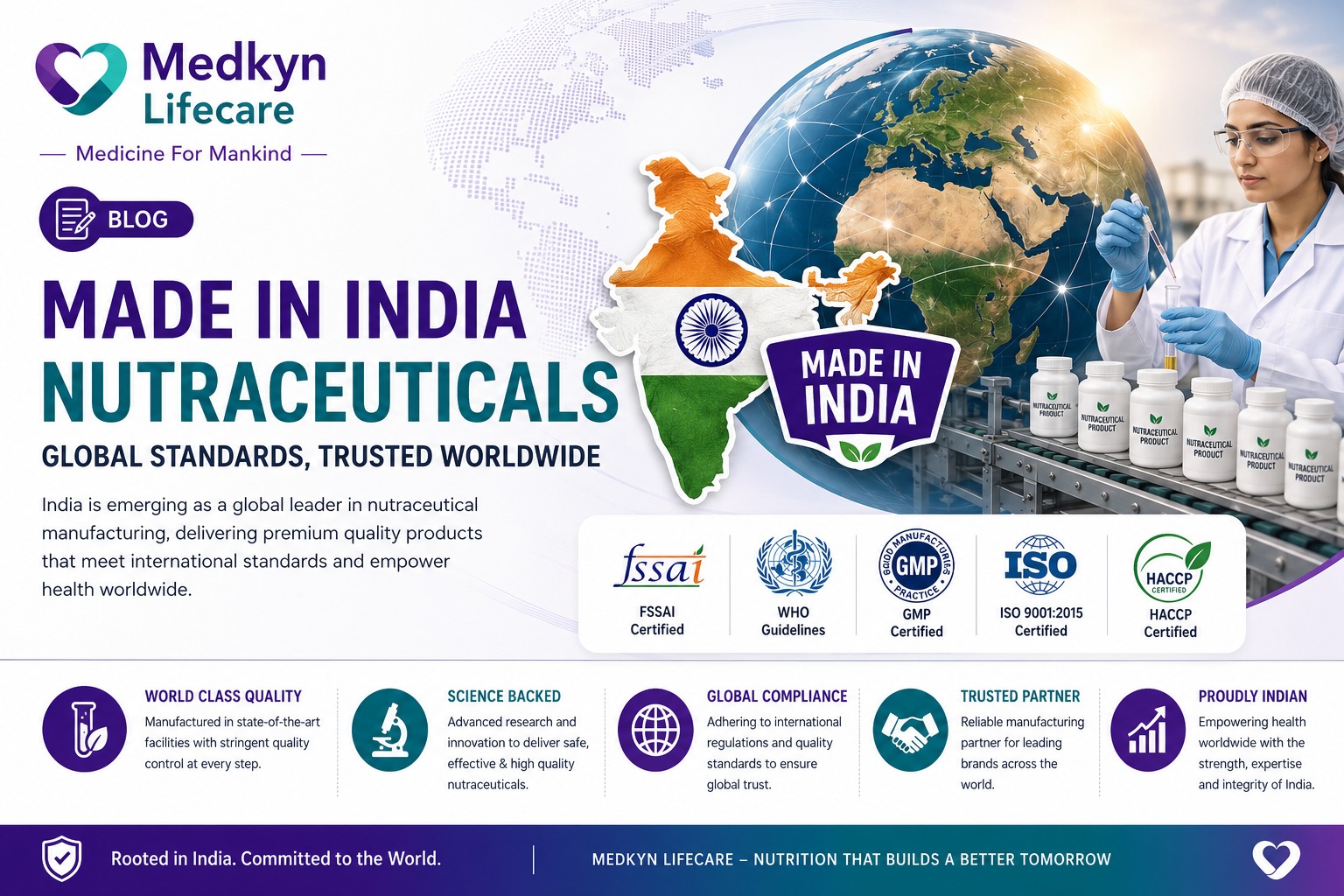
Medkyn Lifecare manufactures the Vitakyn and Argikyn nutraceutical ranges under WHO-GMP, FSSAI and ISO 9001:2015 in Ahmedabad and appoints distributors, stockists and pharmacy partners across India on a territory basis, with distributor pricing, MOQ sheets, product documentation and marketing material. If you already have retailer coverage or a doctor network in your region, our step-by-step guide to becoming a pharma or nutraceutical distributor in India explains the process, and the distributor enquiry form is the fastest way to start the conversation.
Frequently asked questions
What is the difference between a PCD pharma franchise and a distributorship?
In a PCD franchise you receive monopoly marketing rights for a company's brands in a territory, buy at net rates, promote to doctors and chemists yourself and keep the spread. In a distributorship you buy stock at a fixed margin and supply retailers and institutions, while the company generates demand through its own marketing. PCD carries higher margin and higher promotional risk; distribution offers steadier, lower margins.
Do I need a drug licence to distribute nutraceuticals in India?
No. Nutraceuticals and health supplements are regulated as foods by FSSAI, so a distributor needs an FSSAI registration or licence and GST — not a wholesale drug licence. Distributing pharmaceuticals, by contrast, requires a wholesale drug licence in Form 20B and 21B from the state drug control authority.
How much investment is needed to start a pharma or nutraceutical distributorship?
It varies with territory size and the brands carried. Costs include the initial stock order, a compliant storage premises, delivery capacity, licences (FSSAI or drug licence, GST) and working capital to extend credit to retailers. Nutraceutical distributorships usually start at a lower investment than pharmaceutical ones because the licensing and premises requirements are simpler.
Does Medkyn Lifecare appoint distributors?
Yes. Medkyn Lifecare appoints distributors, stockists and pharmacy partners across India for its Vitakyn and Argikyn nutraceutical ranges, which are manufactured under WHO-GMP, FSSAI and ISO 9001:2015 standards in Ahmedabad. Interested partners can submit the distributor enquiry form on this site with their region and current portfolio to receive terms, MOQs and margins.