A pharma or nutraceutical distributor buys finished products in volume from a manufacturer and supplies them onward to retailers, pharmacies, hospitals, and institutional buyers within a defined territory. To do this legally in India you generally need the right licences — a wholesale drug licence for medicines, an FSSAI licence for supplements, plus GST and a trade licence — and a reliable manufacturer partner. Medkyn Lifecare, a WHO-GMP certified, FSSAI-approved, ISO 9001:2015 certified manufacturer in Ahmedabad, Gujarat, India, works with distributors across both its pharmaceutical and nutraceutical ranges.
India's pharmaceutical and nutraceutical market is large, fast-growing, and built on a long supply chain that connects manufacturers to the patients and consumers who finally use the product. Distributors sit at the heart of that chain. If you are planning to start a pharmaceutical distribution business in India — or to add a supplement line to an existing one — this guide walks through how distribution works, the licences you need, what to look for in a manufacturer, the margins to expect, and how to begin a distributor enquiry with Medkyn.
What does a pharma or nutraceutical distributor do?
A distributor is the link between the factory and the point of sale. In India, the typical flow runs manufacturer → distributor or stockist → retailer, pharmacy, or hospital → end user. The manufacturer makes and packs the product; the distributor purchases it in bulk, holds inventory, manages local logistics and credit, and supplies smaller quantities to retailers and institutions across an assigned area.
The role is more than moving boxes. A good distributor maintains correct storage conditions, tracks batch numbers and expiry dates, handles returns, supports local promotion, and keeps products available so a pharmacy or hospital never runs short. For nutraceuticals and health supplements, distributors also help brands reach chemists, wellness stores, gyms, and clinics that a manufacturer cannot service directly.
What licences do you need to become a distributor in India?
The exact paperwork depends on what you distribute and your state, but the core requirements are well established. Treat the list below as a general starting point and always confirm current rules with your State Drugs Control Authority and FSSAI before you commit.
For distributing pharmaceutical drugs
- Wholesale Drug Licence — Form 20B and 21B, issued by your State Drugs Control Authority. This is the central permission to stock and sell medicines wholesale.
- Registered pharmacist or competent person — drug licences generally require a qualified pharmacist or a person with the prescribed experience to supervise the business.
- Suitable premises — a minimum area with proper storage, and refrigeration where cold-chain products are handled.
- GST registration and a trade licence — required for tax compliance and to operate the business locally.
For distributing nutraceuticals and supplements
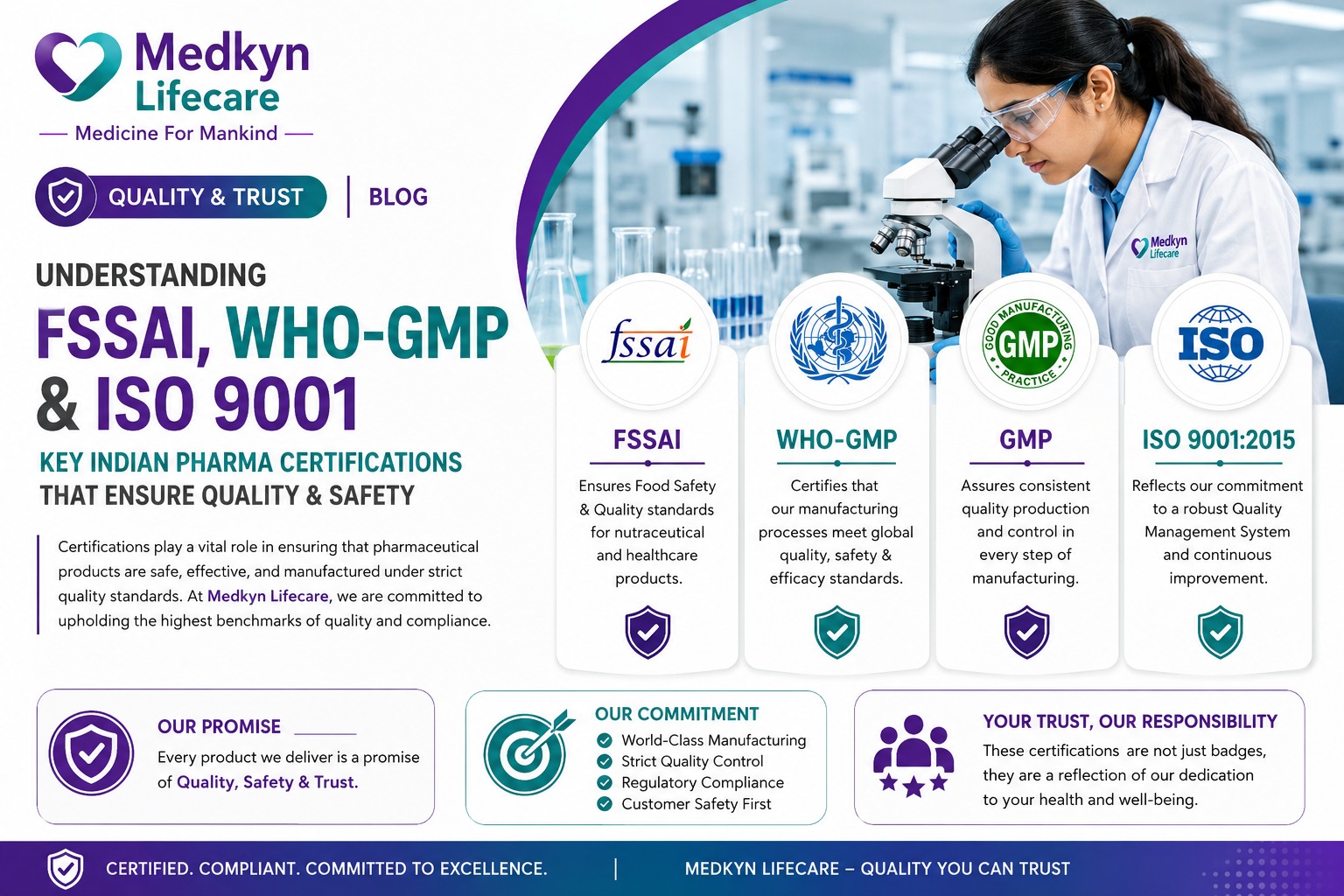
Health supplements and nutraceuticals are regulated as food in India, so the licensing route is different. You will generally need an FSSAI licence or registration (the category depends on your turnover and scale), along with GST registration and a trade licence. You can read more about how food and pharma credentials differ in our guide to FSSAI, WHO-GMP, and ISO 9001 certifications.
Because rules change and vary by state, verify current requirements directly with the relevant authorities — the CDSCO framework and your State Drugs Control Authority for drugs, and the FSSAI for supplements.
What should you look for in a manufacturer partner?
The manufacturer you choose shapes your business more than almost any other decision. Their quality determines your complaint rate; their reliability determines whether your shelves stay stocked. When you evaluate a partner, look closely at:
- Certifications — WHO-GMP, FSSAI, and ISO 9001:2015 together signal a manufacturer that controls quality across both pharma and nutraceutical lines.
- Product range and quality — a broad, well-formulated catalogue lets you serve more of your market from one source.
- Pricing and margins — competitive landed cost and workable margins for your category and territory.
- MOQs — minimum order quantities that match the scale you can realistically move.
- Marketing and packaging support — promotional material, visual identity, and packaging that help products sell.
- Supply reliability — consistent lead times so you are never out of stock on fast movers.
- Documentation — a Certificate of Analysis (CoA) and full batch traceability with every consignment.
- Territory terms — clear, fair agreements on the area and exclusivity you are granted.
You can review Medkyn's full set of credentials on the quality and certifications page and browse the available catalogue across the Vitakyn and Argikyn ranges. To understand why WHO-GMP in particular is a non-negotiable filter, see our explainer on what WHO-GMP certification means.
Your distribution business inherits your manufacturer's quality system. Choose the partner first, and the rest of the model gets easier.
What margins can distributors expect?
This is the question every prospective distributor asks, and the honest answer is that margins vary and are best confirmed with the manufacturer. As a general rule, distributor and wholesale margins are typically lower than retailer margins, because the distributor handles volume rather than individual sales. Branded and specialised products can carry better margins than commodity generics, and factors like order size, payment terms, and territory all influence the final number.
Rather than chase a single percentage figure, evaluate the whole picture: landed cost, volume, payment terms, supply reliability, and how easily the product sells in your market. A slightly lower margin on a fast-moving, well-supported product often beats a higher margin on something that sits in your warehouse. Ask the manufacturer for indicative terms on the specific range and territory you are considering.
Not sure whether a distributorship or a PCD franchise is the right model for you? Our comparison of PCD pharma franchise vs distributorship in India lays out margins, licences and investment side by side.
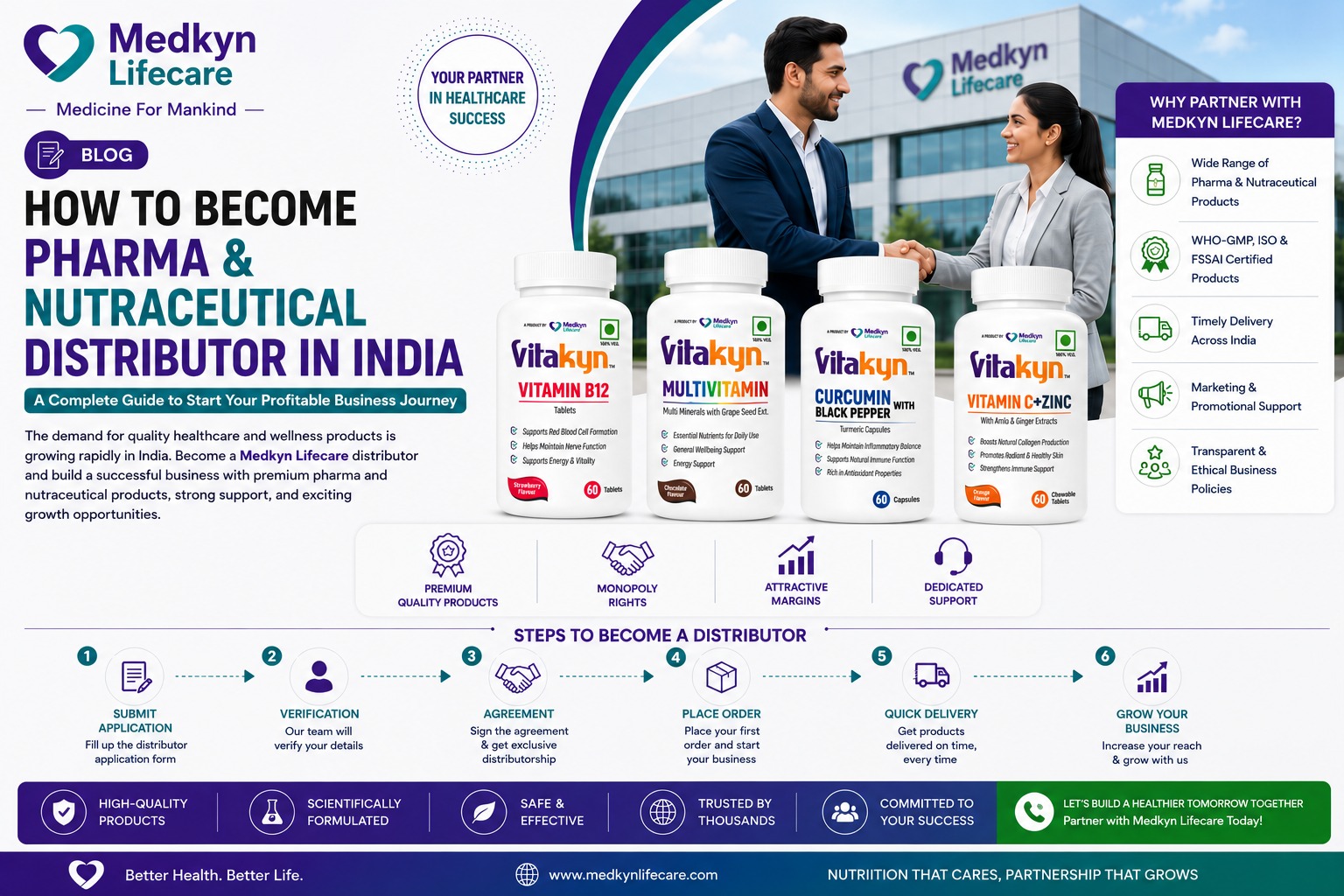
How do you become a Medkyn Lifecare distributor?
Medkyn Lifecare, Ahmedabad, partners with distributors across both its pharmaceutical formulations and its Vitakyn and Argikyn nutraceutical ranges — all made under one WHO-GMP certified, FSSAI-approved, ISO 9001:2015 certified quality system. Getting started is straightforward:
- Confirm your licences. Ensure you hold the right registrations for what you intend to carry — a wholesale drug licence for medicines, an FSSAI licence for supplements, plus GST and a trade licence.
- Define your territory and categories. Decide the area you can cover and which ranges you want to distribute.
- Start a distributor enquiry. Submit your details through the distributor enquiry page with your location, target categories, and existing licences.
- Discuss range, pricing, and terms. The Medkyn team will walk you through the catalogue, indicative pricing, MOQs, and territory terms.
- Onboard and place your first order. Finalise the agreement, receive product documentation, and begin supplying your market.
If you would rather talk it through first, the contact page is the quickest way to reach the team. For brand owners considering their own label rather than distribution, our overview of third party pharmaceutical manufacturing in Ahmedabad is a useful companion read.
- A distributor buys in volume from a manufacturer and supplies retailers, pharmacies, hospitals, and institutions within a territory.
- Distributing medicines generally needs a wholesale drug licence (Form 20B/21B) with a pharmacist and proper premises; supplements need an FSSAI licence — both alongside GST and a trade licence.
- Choose a manufacturer on certifications (WHO-GMP, FSSAI, ISO 9001:2015), range, pricing, MOQs, support, reliability, and documentation.
- Distributor margins vary by category and product and are best confirmed directly with the manufacturer — not assumed from a fixed figure.
- Medkyn Lifecare, Ahmedabad works with distributors across both pharma and nutraceutical ranges; start a distributor enquiry to discuss terms.
Frequently asked questions
What licence do I need to become a pharma distributor in India?
To distribute pharmaceutical drugs wholesale in India you generally need a wholesale Drug Licence (Form 20B and 21B) issued by your State Drugs Control Authority, along with GST registration and a trade licence. The drug licence usually requires a registered pharmacist or a competent person and suitable premises with proper storage and refrigeration. Confirm current requirements with your State Drugs Control Authority.
Do I need an FSSAI licence to distribute supplements?
Yes. Health supplements and nutraceuticals are regulated as food in India, so distributing them generally requires an FSSAI licence or registration in addition to GST registration. The category of FSSAI licence depends on your turnover and scale. Confirm the current requirements with FSSAI.
What margins do pharma distributors make?
Distributor and wholesale margins vary by category and product and are typically lower than retailer margins, while branded and specialised products can carry better margins. There is no single fixed figure — margins are best confirmed directly with the manufacturer for a given product range and territory.
How do I become a Medkyn Lifecare distributor?
Start a distributor enquiry through the Medkyn Lifecare distributor enquiry or contact page with your territory, the categories you want to carry, and your existing licences. Medkyn is a WHO-GMP certified, FSSAI-approved, ISO 9001:2015 certified manufacturer in Ahmedabad, Gujarat, and the team will discuss product range, pricing, and territory terms with you.