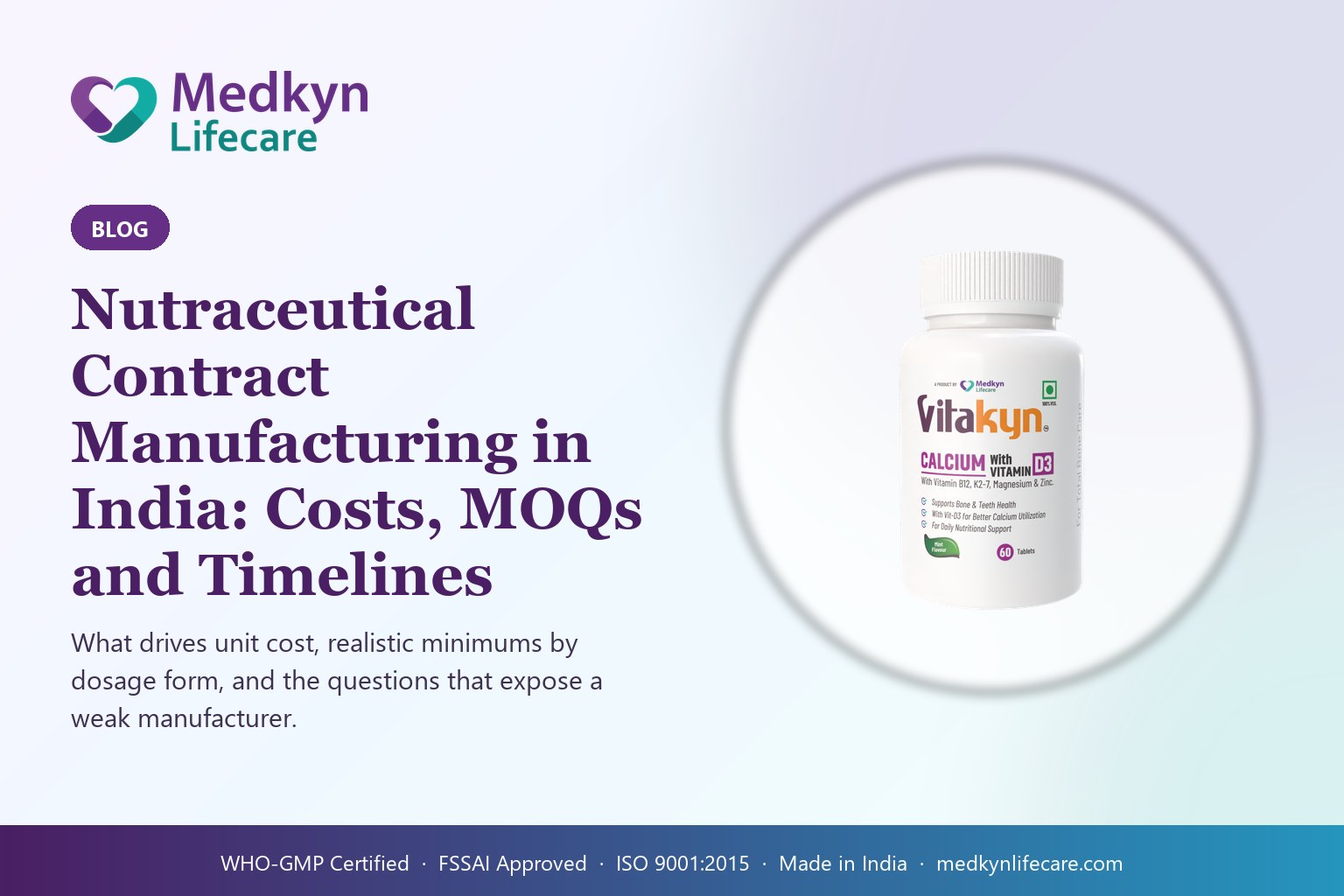
Nutraceutical contract manufacturing is when a licensed facility produces finished supplements — tablets, capsules, soft gels, granules — under your brand, to your specification or theirs. In India the cost of a finished unit is driven by five things: the active ingredients and their grade, the dosage form, the batch size, packaging, and the level of testing and documentation you require. This guide gives realistic ranges for minimum order quantities, a step-by-step timeline from brief to dispatch, and the questions that separate a genuine manufacturer from a trader with a letterhead.
Three models, one licence question
Contract manufacturing comes in three flavours, and the first thing to decide is which one you need:
- Third-party manufacturing of an existing formula. The manufacturer already makes a curcumin capsule or a calcium-D3 tablet; you put your brand on it. Fastest and cheapest, because the formulation, stability data and artwork templates exist.
- Custom formulation. You specify actives, doses and format; the manufacturer develops the formula, sources ingredients, and runs trial batches. More time, more money, a product only you sell.
- Private label from stock. The manufacturer holds finished bulk; you order labelled packs in small runs. Lowest MOQ, least control.
Whichever you choose, in India the pack must carry the manufacturer's FSSAI licence number and yours as marketer. You will need your own FSSAI licence (Central licence for multi-state sales) before the first pack can ship — we cover the regulatory side in pharmaceutical vs nutraceutical: what's the difference.
What actually drives the cost per unit
| Cost driver | Why it matters | What moves it |
|---|---|---|
| Active ingredients | Often 40–70% of unit cost | Standardised extracts (e.g. 95% curcuminoids) vs crude powders; imported vs domestic; certified vs uncertified sources |
| Dosage form | Each form needs different machinery and yield | Tablets are cheapest; soft gels and sachets cost more; chewables need flavour and sweetener systems |
| Batch size | Fixed costs — line set-up, cleaning validation, QC testing — spread over units | A 50,000-unit batch can cost far less per unit than a 5,000-unit batch of the same product |
| Packaging | Bottle, cap, label, carton, shipper | HDPE bottle vs blister vs sachet; printed carton vs none; insert leaflets |
| Testing & documentation | Assay, microbiology, heavy metals, stability | In-house QC vs third-party lab; batch COA is standard; stability studies for new formulas add cost and time |
Two costs that new brands under-estimate: artwork and regulatory review (every label must be checked against FSSAI labelling rules before printing) and working capital — most manufacturers ask for an advance on ingredients and packaging, with balance before dispatch.
Realistic minimum order quantities
MOQs exist because a production line has to be set up, cleaned and validated for each product regardless of how many units come off it. Typical ranges in the Indian nutraceutical market:
- Tablets and capsules (existing formula): commonly 5,000–10,000 units per SKU; some manufacturers go lower for stock formulas.
- Custom formulations: usually higher — a full batch of 25,000–1,00,000 units — because the run has to justify development and validation.
- Soft gels: higher MOQs, as encapsulation lines are expensive to set up and often outsourced to specialist units.
- Sachets / granules: MOQ is usually expressed in kilograms of blend rather than units; 100–500 kg is a common floor.
Ask for the MOQ per SKU and whether it can be split across flavours or pack sizes. Also ask about packaging MOQs separately — printed cartons and labels frequently have minimum print runs larger than your first batch.
- Unit cost is mostly actives + dosage form + batch size. Get quotes at two batch sizes to see the curve.
- Expect MOQs of a few thousand units for stock formulas and a full batch for custom ones.
- A realistic timeline from signed brief to dispatch is 8–14 weeks for a stock formula; longer if stability data is needed.
- Insist on a batch Certificate of Analysis, a copy of the WHO-GMP and FSSAI certificates, and a written quality agreement.
- Visit the facility. A trader cannot show you a tablet press.
Timeline: from brief to dispatch
- Brief and quotation (1–2 weeks). Product, format, dose, pack size, target quantity. You receive a per-unit quote, MOQ and payment terms.
- Formulation sign-off (1–3 weeks). For stock formulas this is a spec sheet. For custom work, trial batches and a written specification with assay limits.
- Artwork and label compliance (2–3 weeks). Composition table, % RDA, mandatory statements, both FSSAI numbers, veg/non-veg mark. The manufacturer's regulatory team should review before print.
- Raw material and packaging procurement (2–4 weeks). Extracts with certificates from approved vendors; bottles, caps, labels and cartons to your artwork.
- Manufacturing and packing (1–2 weeks). Blending, compression or encapsulation, coating, in-process checks, primary and secondary packing.
- QC release (1–2 weeks). Finished-product testing — assay, disintegration, microbiology, heavy metals as applicable — and issue of the Certificate of Analysis.
- Dispatch. With COA, invoice, and batch records available on request.
Add 8–12 weeks if a new formula needs accelerated stability data before a shelf life can be assigned.
Documents you should receive — every time
- Copies of the manufacturer's WHO-GMP, ISO 9001:2015 and FSSAI certificates — and permission to check them at source.
- A product specification with assay limits, physical parameters and microbial limits.
- A Certificate of Analysis for every batch, signed by QC. We explain what to check on it in our COA guide.
- A quality / technical agreement defining responsibilities, change control, complaints and recall handling.
- Raw material vendor certificates for key actives on request.
Ten questions that expose a weak manufacturer
- Can I visit the facility, and see the line my product will run on?
- Is the WHO-GMP certificate in your company's name, and can I verify it?
- Who performs QC testing — in-house lab or third party — and can I see a recent COA?
- What is your batch record retention period?
- How do you handle a deviation or out-of-specification result?
- What stability data supports the shelf life on the label?
- Who reviews artwork for FSSAI compliance before printing?
- What is the MOQ per SKU, and the per-unit price at 2× MOQ?
- What are the payment terms and the lead time for a repeat order?
- Do you manufacture both pharmaceutical and nutraceutical products — and under the same quality system?
The last question matters more than it looks. A facility that runs pharmaceuticals to WHO-GMP applies the same batch control, documentation and release discipline to its nutraceuticals. That is the basis on which Medkyn Lifecare offers contract manufacturing in Ahmedabad — one quality system, both categories.
Why Gujarat
Ahmedabad and the surrounding GIDC estates form one of India's densest pharmaceutical manufacturing clusters, with deep supplier networks for excipients, packaging and testing labs, and a regulatory ecosystem used to WHO-GMP audits. For a brand owner that means shorter lead times, competitive pricing and a manufacturer you can actually visit. Our earlier article on third-party pharmaceutical manufacturing in Ahmedabad covers the cluster in more depth.
Frequently asked questions
What is the minimum order quantity for nutraceutical contract manufacturing in India?
It depends on the dosage form and whether the formula already exists. Stock tablets and capsules commonly start around 5,000–10,000 units per SKU; custom formulations usually require a full production batch, often 25,000 units or more; soft gels carry higher minimums; and sachets are quoted in kilograms of blend. Always confirm packaging print-run minimums separately.
How long does contract manufacturing take from order to delivery?
For an existing formula, a realistic end-to-end timeline is 8–14 weeks: quotation, specification sign-off, artwork compliance review, raw material and packaging procurement, manufacturing, QC release and dispatch. A new custom formula that needs stability data before a shelf life can be assigned can add another 8–12 weeks.
Do I need my own FSSAI licence to sell contract-manufactured supplements?
Yes. Indian nutraceutical packs must carry the FSSAI licence numbers of both the manufacturer and the marketer (brand owner). If you sell across states you will need a Central FSSAI licence for your company before the first pack ships, in addition to the manufacturer's own licence.
Does Medkyn Lifecare offer nutraceutical contract manufacturing?
Yes. Medkyn Lifecare offers contract and third-party manufacturing of pharmaceutical and nutraceutical products — tablets, capsules, soft gels, chewables, granules and sachets — from a WHO-GMP certified, FSSAI-approved, ISO 9001:2015 facility in Ahmedabad, Gujarat, with a Certificate of Analysis issued for every batch. MOQs and pricing are quoted per project.