Omega-3 fatty acids are polyunsaturated fats the body cannot make efficiently on its own. The two that matter most in fish oil are DHA (docosahexaenoic acid), a structural fat concentrated in the brain and retina, and EPA (eicosapentaenoic acid), which is more involved in the body's inflammatory signalling. Most Indian diets — especially vegetarian ones — provide very little of either. This guide explains what each does, how much adults typically need, and what to check on a fish oil label before you buy.
What omega-3s are, in plain language
"Omega-3" is a family of fats, not a single nutrient. Three members matter for people:
- ALA (alpha-linolenic acid) — found in flaxseed, chia, walnuts and mustard oil. The body converts only a small fraction of ALA into EPA and DHA, so plant sources alone rarely deliver meaningful amounts of the two "active" omega-3s.
- EPA — found in oily fish and fish oil. Widely studied for its role in the body's inflammatory balance and in supporting normal triglyceride levels.
- DHA — also from fish. A structural component of cell membranes, making up a large share of the fatty acids in the brain's grey matter and the retina. It is the omega-3 most associated with brain, eye and pregnancy nutrition.
DHA vs EPA: what each one does
| DHA | EPA | |
|---|---|---|
| Main role | Structural — brain, retina, nerve cell membranes | Signalling — precursor to anti-inflammatory mediators |
| Most discussed for | Cognitive support, eye health, foetal brain development | Cardiovascular markers, mood research, joint comfort |
| Where it concentrates | Brain, eyes | Blood, immune cells |
| Typical fish oil ratio | Standard fish oil is roughly 12% EPA / 18% DHA of total oil; formulated products vary widely, so always read the per-capsule figures | |
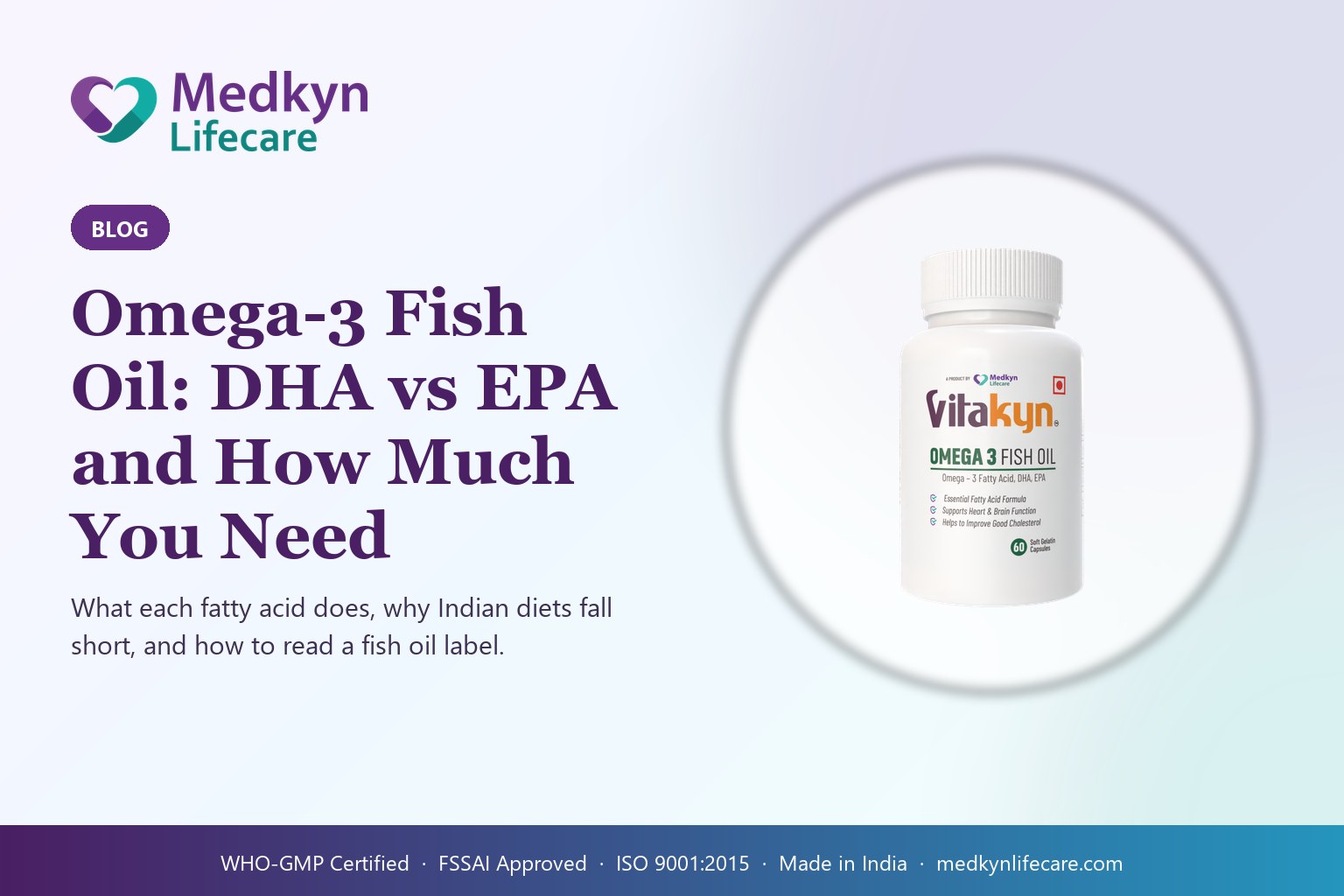
Neither is "better". They are complementary, and most authorities express intake as combined EPA + DHA. A formula that leans towards DHA — like Vitakyn Omega 3, which supplies 300 mg DHA and 60 mg EPA per soft gel — is aimed squarely at everyday brain, eye and general wellness support rather than the high-EPA doses doctors sometimes prescribe for specific lipid conditions.
How much omega-3 do adults need?
There is no single Indian RDA for EPA and DHA; the ICMR-NIN 2020 guidelines express omega-3 needs largely as a share of total fat intake, and international bodies such as the WHO/FAO and EFSA commonly cite around 250 mg of combined EPA + DHA per day for healthy adults as a reasonable target. Pregnant women are frequently advised to ensure an additional intake of DHA specifically — a decision to make with an obstetrician.
Two oily-fish meals a week roughly meets that target. For the majority of Indians who eat fish rarely or not at all, a fish oil supplement is the practical route. One Vitakyn Omega 3 soft gel provides 360 mg of EPA + DHA, which comfortably covers the widely cited daily figure.
- Fish oil matters for its EPA and DHA, not its total "omega-3" number. Read the per-capsule breakdown.
- Around 250 mg/day of EPA + DHA is the figure most authorities cite for healthy adults.
- Plant ALA (flax, chia, walnuts) converts poorly to EPA and DHA — it is not a like-for-like substitute.
- Fish oil is non-vegetarian. Vitakyn Omega 3 is the only non-veg product in the Vitakyn range.
- Take with a meal, store cool and dry, and speak to a doctor if you are on blood thinners or pregnant.
Why Indian diets fall short
Three things work against omega-3 status in India. First, a large share of the population is vegetarian, so preformed EPA and DHA from fish are absent. Second, the most common cooking oils — refined sunflower, safflower and soybean — are rich in omega-6 linoleic acid, which competes with omega-3 for the same conversion enzymes. Third, even among fish-eaters, freshwater fish common in Indian cooking generally contain less EPA and DHA than cold-water marine species like sardine, mackerel or salmon. The result is a diet that is heavy in omega-6 and light in omega-3 — the opposite of what the cardiovascular literature encourages.
How to read a fish oil label
- EPA and DHA in milligrams per serving. "1000 mg fish oil" says nothing about actives. Vitakyn Omega 3's label declares 600 mg omega-3 fatty acids, of which 300 mg DHA and 60 mg EPA.
- Serving size. Some brands quote figures for two or three capsules. Check whether the numbers are per soft gel.
- Capsule shell. Fish oil soft gels almost always use gelatin (E441) of animal origin — which is why the product is labelled non-vegetarian.
- Antioxidant. Omega-3 oils oxidise easily. An added antioxidant (Vitakyn uses E321) and opaque packaging protect the oil's freshness.
- Manufacturer credentials. Look for an FSSAI licence number on the pack and a manufacturer that operates to WHO-GMP — the difference between a supplement made in a certified facility and one that is simply "packed".
- The compliance line. Every Indian nutraceutical must state "Not for medicinal use" and carry % RDA values where established. Its absence is a red flag. See our full guide to reading supplement labels in India.
How to take fish oil
Take it with a meal that contains some fat — absorption of omega-3 is noticeably better with food than on an empty stomach. Splitting the dose across meals reduces the fishy after-taste some people notice. Keep the bottle away from heat and sunlight; a refrigerator is fine in Indian summers. The Vitakyn label directs one soft gel daily or as advised by a dietician.
Who should be careful
Omega-3 has a mild blood-thinning effect. Anyone on anticoagulant or antiplatelet medication, anyone scheduled for surgery, and anyone with a fish or shellfish allergy should speak to a doctor first. Pregnant and breastfeeding women are often advised to take DHA, but the dose should come from their obstetrician. As with every nutraceutical, a supplement fills a gap; it does not replace a diagnosis.
Where Vitakyn Omega 3 fits
Vitakyn Omega 3 Fish Oil is a 60-soft-gel pack manufactured under WHO-GMP and FSSAI standards for Medkyn Lifecare, Ahmedabad. It is a DHA-forward daily formula (300 mg DHA, 60 mg EPA per soft gel) intended for heart, brain, eye, skin and joint support in adults. It is available to consumers on Amazon and Flipkart and to distributors and pharmacies across India.
Frequently asked questions
What is the difference between DHA and EPA?
DHA (docosahexaenoic acid) is a structural omega-3 fat that makes up a large share of the fatty acids in the brain and retina, so it is associated with cognitive, eye and pregnancy nutrition. EPA (eicosapentaenoic acid) is more involved in the body's inflammatory signalling and is the omega-3 most studied for cardiovascular markers. Fish oil supplements contain both; the ratio varies by product.
How much omega-3 should an adult take per day?
International bodies such as the WHO/FAO and EFSA commonly cite around 250 mg per day of combined EPA and DHA for healthy adults. ICMR-NIN 2020 frames omega-3 mainly as a share of total fat intake. One Vitakyn Omega 3 soft gel supplies 360 mg of EPA plus DHA. Higher doses for specific conditions should only be taken on a doctor's advice.
Is fish oil vegetarian?
No. Fish oil is extracted from fish and the soft gel shell is usually gelatin of animal origin, so fish oil supplements — including Vitakyn Omega 3 — are non-vegetarian. Every other product in the Vitakyn range is 100% vegetarian. Plant sources such as flaxseed provide ALA, which the body converts to EPA and DHA only in small amounts.
When is the best time to take omega-3 capsules?
With a meal that contains some fat. Omega-3 fatty acids are absorbed far better alongside dietary fat than on an empty stomach, and taking the capsule with food also reduces the fishy after-taste. Consistency matters more than timing — the same meal each day is easiest to remember.