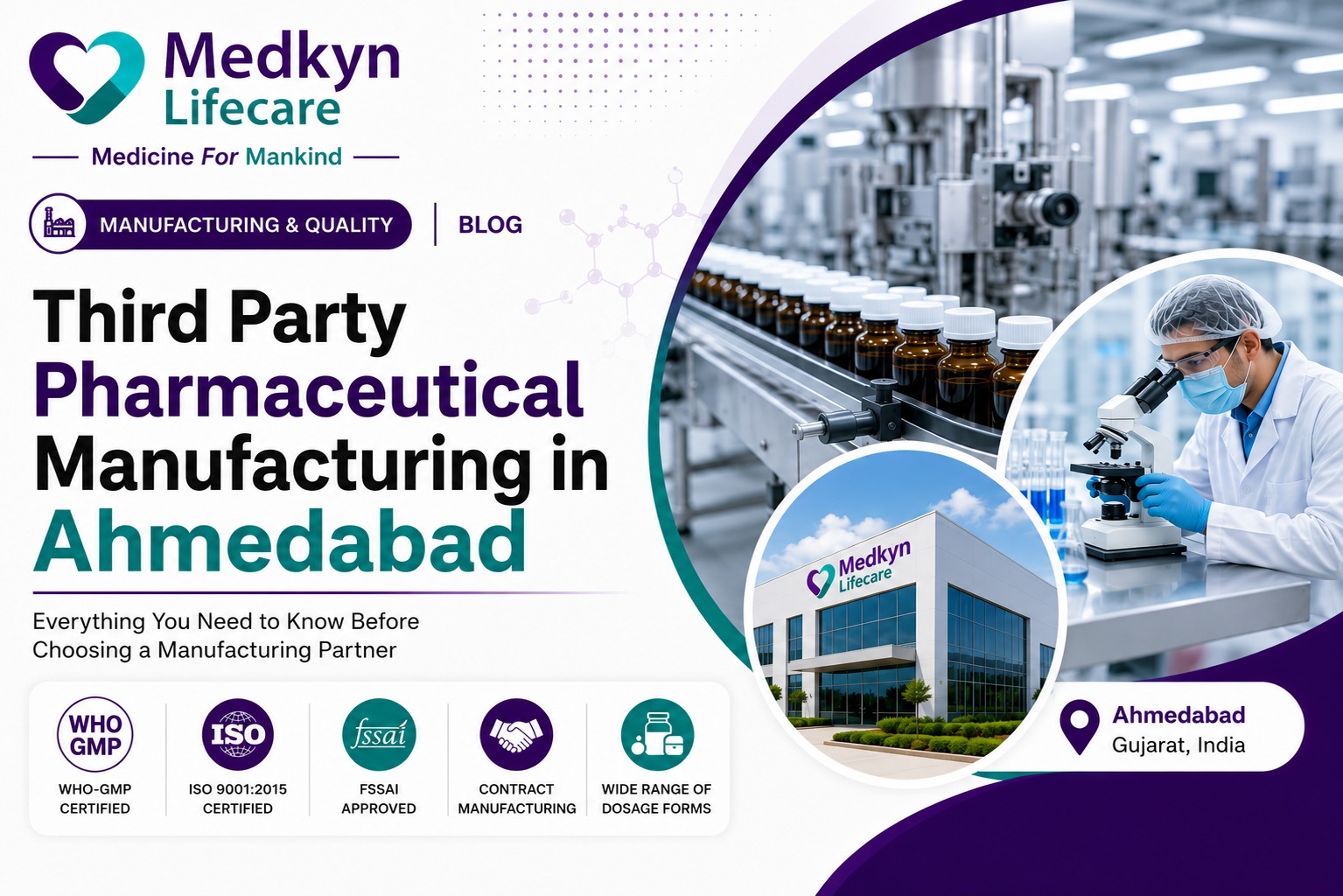
Third party pharmaceutical manufacturing — also called contract manufacturing — is an arrangement where a brand owner gets its products made by a separate licensed manufacturer that handles formulation, production, packaging, and quality control, while the brand markets and sells the finished goods under its own label. It lets a company build a product range without owning a factory or holding a manufacturing licence. Medkyn Lifecare offers third party and contract manufacturing for both pharmaceutical and nutraceutical products at its WHO-GMP certified facility in Ahmedabad, Gujarat, India.
For most brand owners, building a compliant pharmaceutical plant from scratch is neither practical nor affordable. Third party manufacturing solves that: you keep the brand, the marketing, and the customer relationship, and a licensed partner handles the regulated work of making the product. Ahmedabad, at the centre of Gujarat's pharma cluster, is one of the most efficient places in India to do exactly that.
What is third party pharmaceutical manufacturing?
In a third party arrangement, the brand owner provides the product brief — formulation, dosage form, pack size, and label — and the manufacturer produces it on its own licence, using its own facility, equipment, and quality systems. The finished goods are supplied to the brand, who sells them under its own name. Because the term is used loosely, it helps to separate it from two adjacent models.
How it differs from in-house manufacturing
With in-house manufacturing, the brand owns the plant, holds the manufacturing licence, and carries the full cost and compliance burden of running a facility. Third party manufacturing shifts that capital expense and regulatory responsibility to a specialist partner, so the brand can launch faster and focus on distribution and marketing.
How it differs from loan licensing
Loan licensing is a related but distinct model: the brand holds its own manufacturing licence and produces using another company's premises and machinery. In third party manufacturing, the contract manufacturer holds the licence and owns the process end to end — which keeps accountability for quality and documentation in a single place.
Why is Ahmedabad a hub for pharma manufacturing?
Gujarat is India's largest pharmaceutical manufacturing state, and Ahmedabad sits at the heart of that cluster. The advantage is concentration: when suppliers, regulators, talent, and logistics are all close together, lead times shorten and costs fall.
- A dense supplier ecosystem — active pharmaceutical ingredient (API), excipient, and packaging vendors are nearby, which shortens procurement cycles and reduces freight.
- Skilled technical talent — a deep pool of formulators, QA/QC chemists, and machine operators trained in regulated manufacturing.
- An active state regulator — the Gujarat Food and Drug Control Administration (FDCA) issues and oversees manufacturing licences, working alongside the national framework of the Central Drugs Standard Control Organisation (CDSCO).
- Export-ready logistics — proximity to ports and a mature freight network make it straightforward to serve both domestic and export markets.
What should you look for in a third party manufacturer?
The factory tour and the quotation are the easy part. The harder, more important work is vetting whether a partner can deliver compliant, consistent product batch after batch. Use this checklist before you commit.
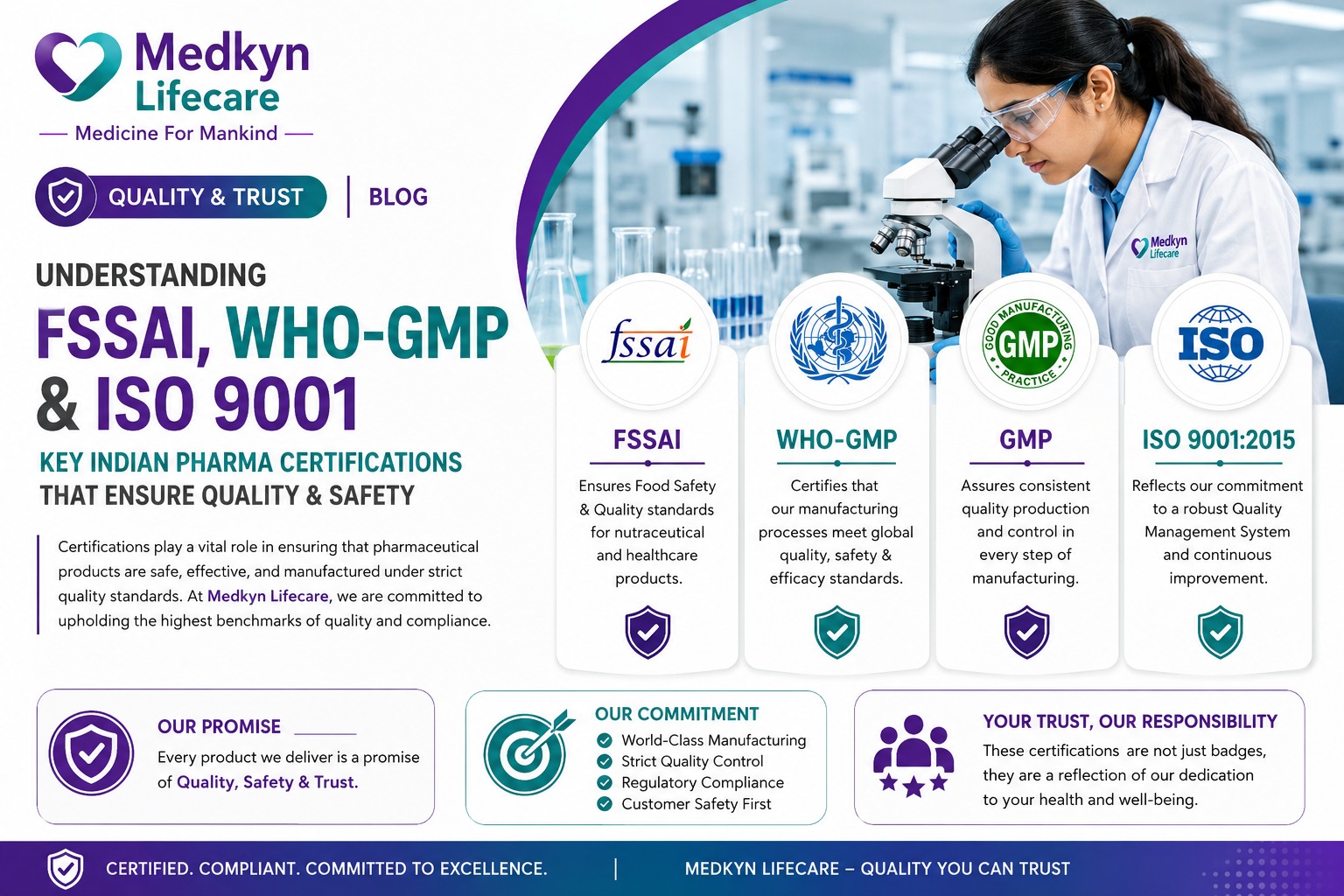
- Certifications — WHO-GMP for pharmaceutical capability, FSSAI approval for nutraceuticals and supplements, and ISO 9001:2015 for quality management. All three together signal a genuinely systematic operation.
- Dosage-form capability — confirm the partner actually makes the formats you need (tablets, capsules, soft gels, sachets, chewables) rather than outsourcing them onward.
- Minimum order quantities (MOQs) — check that the MOQs fit your launch volumes and cash flow, not just the manufacturer's preferred batch sizes.
- Documentation and CoA — every batch should ship with a Certificate of Analysis and traceable batch manufacturing records.
- Capacity and lead times — verify the plant can scale with you and hold reliable delivery dates as your orders grow.
- Single-source accountability — one partner owning formulation through packaging means one point of responsibility when questions arise.
The best third party partner is not the cheapest quote — it is the one whose quality system you would be proud to put your own brand name behind.
What can Medkyn Lifecare manufacture?
Medkyn Lifecare, Ahmedabad, runs third party and contract manufacturing across a broad set of solid and semi-solid dosage forms, all under one WHO-GMP certified, FSSAI-approved, ISO 9001:2015 certified roof. The range includes tablets, capsules, soft gels, granules and sachets, and chewable tablets.
What sets the operation apart is that the same facility serves both pharmaceutical and nutraceutical products. A brand can develop a medicine and a supplement line with a single partner, governed by one quality system — the same discipline behind Medkyn's own Vitakyn wellness and Argikyn women's nutrition ranges. You can review the facility's full credentials on the Medkyn quality and certifications page, and explore the formats and process on the contract manufacturing page.
Choosing the right partner in Ahmedabad
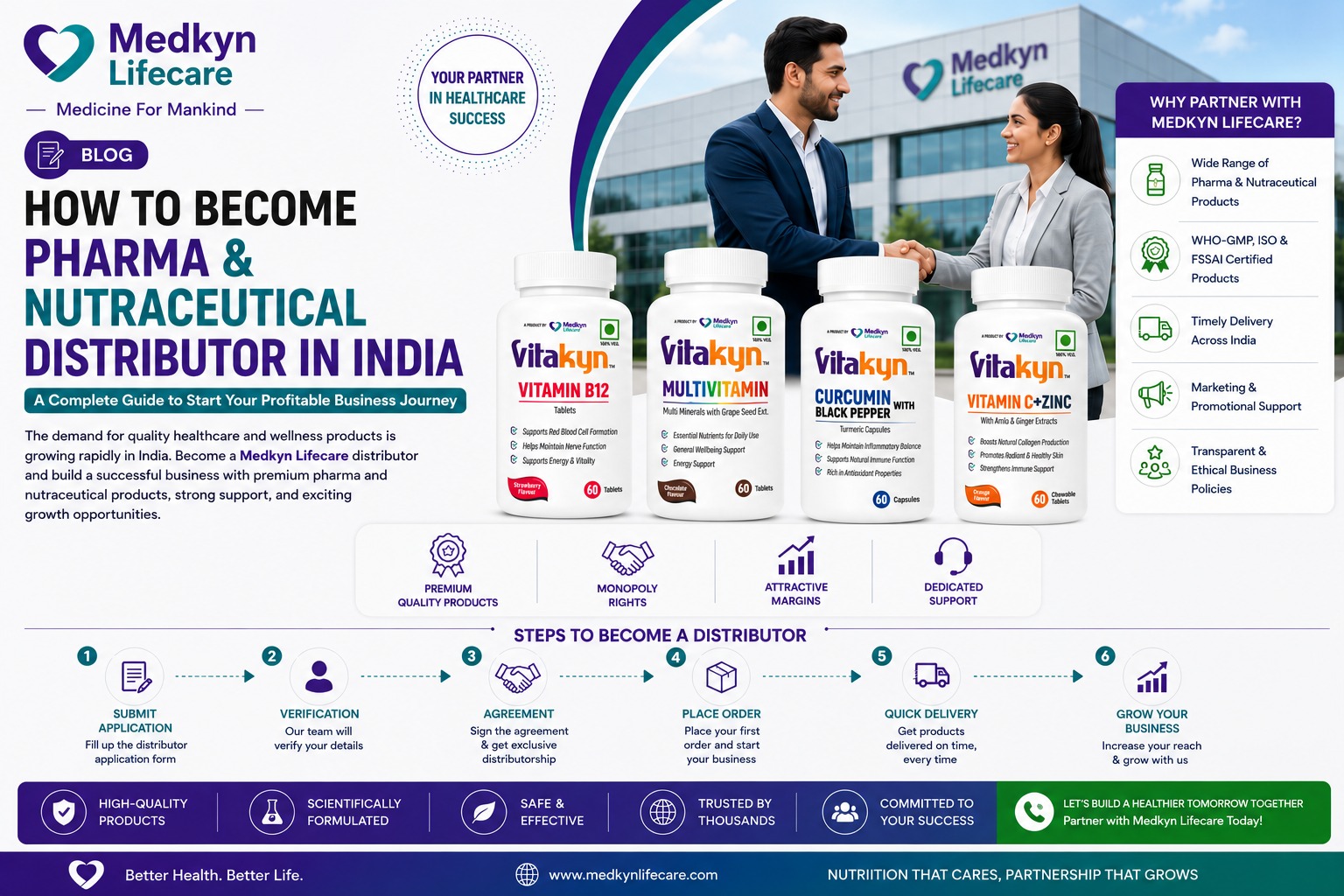
Third party manufacturing works best as a long-term partnership, not a one-off transaction. The right partner combines the right certifications, the dosage forms you need, sensible MOQs, and clear single-source accountability — then backs it with consistent documentation. If you want to understand why the WHO-GMP credential matters so much in that decision, read our explainer on WHO-GMP certification for pharma manufacturers in India. And if you are building a route to market rather than a product, see our guide to becoming a pharma or nutraceutical distributor in India.
- Third party (contract) manufacturing lets a brand produce under a separate licensed manufacturer's roof while keeping the brand, marketing, and sales.
- It differs from in-house manufacturing (you own the plant) and loan licensing (you hold the licence on someone else's premises).
- Ahmedabad, Gujarat is India's leading pharma cluster — dense API and packaging supply, skilled talent, the Gujarat FDCA, and export logistics.
- Vet partners on WHO-GMP, FSSAI, and ISO 9001:2015 certifications, dosage-form capability, MOQs, documentation, capacity, and single-source accountability.
- Medkyn Lifecare, Ahmedabad makes tablets, capsules, soft gels, granules/sachets, and chewables — pharmaceutical and nutraceutical — under one WHO-GMP roof.
Frequently asked questions
What is the difference between third party manufacturing and contract manufacturing?
In practice the two terms are used interchangeably. Both describe an arrangement where a brand owner gets its products made by a separate licensed manufacturer that handles formulation, production, packaging, and quality control, while the brand markets and sells the finished goods under its own label. "Third party manufacturing" is the more common term in the Indian pharma and nutraceutical trade.
Is Ahmedabad good for pharma manufacturing?
Yes. Ahmedabad sits in Gujarat, India's largest pharmaceutical manufacturing cluster, with a dense ecosystem of API and excipient suppliers, packaging vendors, skilled technical talent, an active state regulator in the Gujarat FDCA, and strong export logistics. That concentration shortens supply chains and lowers lead times for third party manufacturing.
Does Medkyn Lifecare do third party nutraceutical manufacturing?
Yes. Medkyn Lifecare manufactures both pharmaceutical and nutraceutical products on a third party and contract basis at its WHO-GMP certified, FSSAI-approved, ISO 9001:2015 certified facility in Ahmedabad, Gujarat. It produces tablets, capsules, soft gels, granules and sachets, and chewable tablets under one quality system.
What certifications should a third party manufacturer have?
At minimum, look for WHO-GMP certification for pharmaceutical capability, FSSAI approval for nutraceuticals and food supplements, and ISO 9001:2015 for quality management. These should be backed by batch documentation and Certificates of Analysis, validated equipment, and clear single-source accountability for every batch.