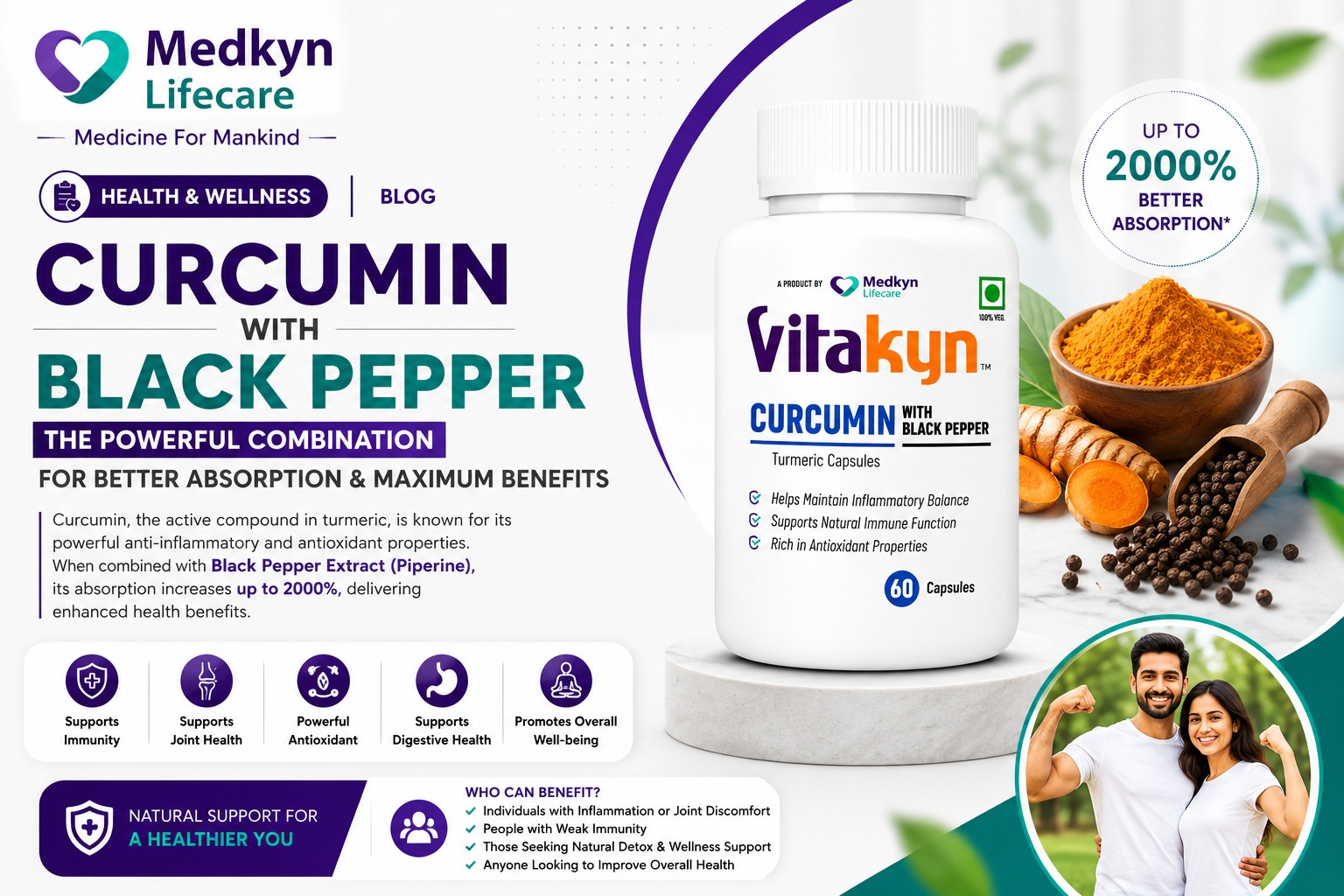
Turmeric is the golden spice made from the root of Curcuma longa, while curcumin is its main active compound — the curcuminoid behind much of turmeric's reputation, making up only about 2–5% of the spice by weight. The catch is that curcumin on its own absorbs poorly and is rapidly cleared by the body. Pairing it with black pepper, whose active compound piperine sharply increases curcumin absorption, is the practical fix. That is exactly how Medkyn Lifecare formulates Vitakyn Curcumin with Black Pepper at its facility in Ahmedabad, Gujarat, India.
If you have ever wondered why so many curcumin supplements list "black pepper extract" right alongside the turmeric, the answer comes down to one word: absorption. Turmeric has been used in Indian kitchens and traditional wellness for centuries, but extracting a meaningful benefit from its star compound requires a little help. This guide explains the difference between turmeric and curcumin, why curcumin is hard to absorb, and how piperine changes the equation.
What is the difference between turmeric and curcumin?
People use the words "turmeric" and "curcumin" almost interchangeably, but they are not the same thing. Turmeric is the whole spice — the dried, ground rhizome (root) of the Curcuma longa plant. It contains hundreds of compounds, including essential oils, fibre, and a family of pigments called curcuminoids.
Curcumin is the most studied curcuminoid within that mix, and it is responsible for much of turmeric's bright yellow colour. Crucially, curcumin is only a small fraction of turmeric — typically around 2–5% by weight. So a spoonful of culinary turmeric contains relatively little actual curcumin.
Why this distinction matters
Because curcumin is such a small part of turmeric, cooking with the spice alone delivers only a modest amount of the compound most people are actually after. A curcumin supplement delivers a measured daily amount, which is why curcumin capsules are popular with people looking for consistent intake rather than guesswork.
Why does curcumin absorb so poorly?
Here is the frustrating part: even when you take concentrated curcumin, your body does not absorb much of it. Curcumin has poor bioavailability — meaning only a small portion reaches the bloodstream in an active form. Several factors work against it at once.
- Low solubility — curcumin does not dissolve easily in water, which limits how much the gut can take up.
- Rapid metabolism — the liver and intestinal wall chemically transform curcumin quickly, before it can do much.
- Fast elimination — what does get absorbed is cleared from the body relatively quickly.
The net effect is that plain curcumin, taken on its own, is largely processed and excreted before it has a chance to be useful. This is a well-recognised limitation, and it is the reason formulators look for ways to improve curcumin's uptake rather than simply increasing the dose.
How does black pepper (piperine) improve curcumin absorption?
Piperine is the active compound that gives black pepper its bite — and it happens to be one of the simplest, best-documented ways to boost curcumin absorption. Piperine slows down some of the metabolic processes that would otherwise break curcumin down too quickly, which lets more of it stay intact and reach the bloodstream.
The most frequently cited evidence comes from a 1998 study by Shoba and colleagues, published in Planta Medica and indexed on PubMed. In that human study, adding piperine to curcumin increased curcumin bioavailability by about 2000% — a striking jump that helped popularise the curcumin-plus-black-pepper pairing now common in supplements.
The active compound matters less than how much of it your body can actually use. With curcumin, absorption is the whole game.
What does Vitakyn Curcumin with Black Pepper offer?
Vitakyn Curcumin with Black Pepper is formulated around exactly this principle: pairing curcumin with black pepper extract so that more of the active compound is absorbed rather than wasted. It is offered as a vegetarian formulation in a pack of 60 capsules, intended to support the body's antioxidant defences and provide anti-inflammatory and antioxidant support as part of a balanced routine.
Like every Vitakyn product, it is made by Medkyn Lifecare, Ahmedabad, at a WHO-GMP certified, FSSAI-approved, ISO 9001:2015 certified facility — the same quality system that governs the company's pharmaceutical output. You can view the full ingredient details and the rest of the range on the Vitakyn product page, or browse all Medkyn products.
How should you take curcumin?
For everyday use, take curcumin capsules with a meal — including some healthy fat can further support uptake, since curcumin is fat-soluble. Always follow the directions on the product label for dose and timing. Curcumin supplements are intended to complement, not replace, a varied diet, and they are not a substitute for medical treatment.
If you are pregnant, breastfeeding, taking medication, or managing a health condition, speak to a doctor or qualified healthcare professional before starting any new supplement. If you have questions about Vitakyn Curcumin specifically, you are welcome to contact the Medkyn team. For broader reading on supplements and how to evaluate them, the U.S. Office of Dietary Supplements is a useful independent resource.
- Turmeric is the spice; curcumin is its main active compound — curcumin is only about 2–5% of turmeric by weight.
- Curcumin on its own has poor bioavailability — it is poorly absorbed and rapidly metabolised.
- Piperine from black pepper substantially boosts curcumin absorption; Shoba et al. (1998) reported an increase of about 2000% in humans.
- Vitakyn Curcumin with Black Pepper is a vegetarian, 60-capsule formula pairing curcumin with black pepper for better uptake.
- It is made by Medkyn Lifecare, Ahmedabad at a WHO-GMP, FSSAI, ISO 9001:2015 certified facility.
Frequently asked questions
Is curcumin the same as turmeric?
No. Turmeric is the spice made from the root of the Curcuma longa plant, while curcumin is the main active curcuminoid found inside turmeric. Curcumin typically makes up only about 2–5% of turmeric by weight, so curcumin is one concentrated component of turmeric rather than the whole spice.
Why is black pepper added to curcumin?
Black pepper contains piperine, a compound shown to substantially increase how much curcumin the body absorbs. Curcumin on its own is poorly absorbed and rapidly metabolised. A widely cited 1998 study by Shoba and colleagues reported that piperine increased curcumin bioavailability by about 2000% in humans, which is why curcumin is often paired with black pepper extract.
How much curcumin should I take daily?
There is no single official daily dose for everyone, and the right amount depends on your health goals and individual circumstances. Always follow the directions on your product label and consult a doctor or qualified healthcare professional before starting any supplement, especially if you are pregnant, breastfeeding, on medication, or managing a health condition.
Is Vitakyn Curcumin vegetarian?
Yes. Vitakyn Curcumin with Black Pepper is a vegetarian formulation, supplied as 60 capsules per pack, manufactured by Medkyn Lifecare at its WHO-GMP certified, FSSAI-approved, ISO 9001:2015 certified facility in Ahmedabad, Gujarat, India.